

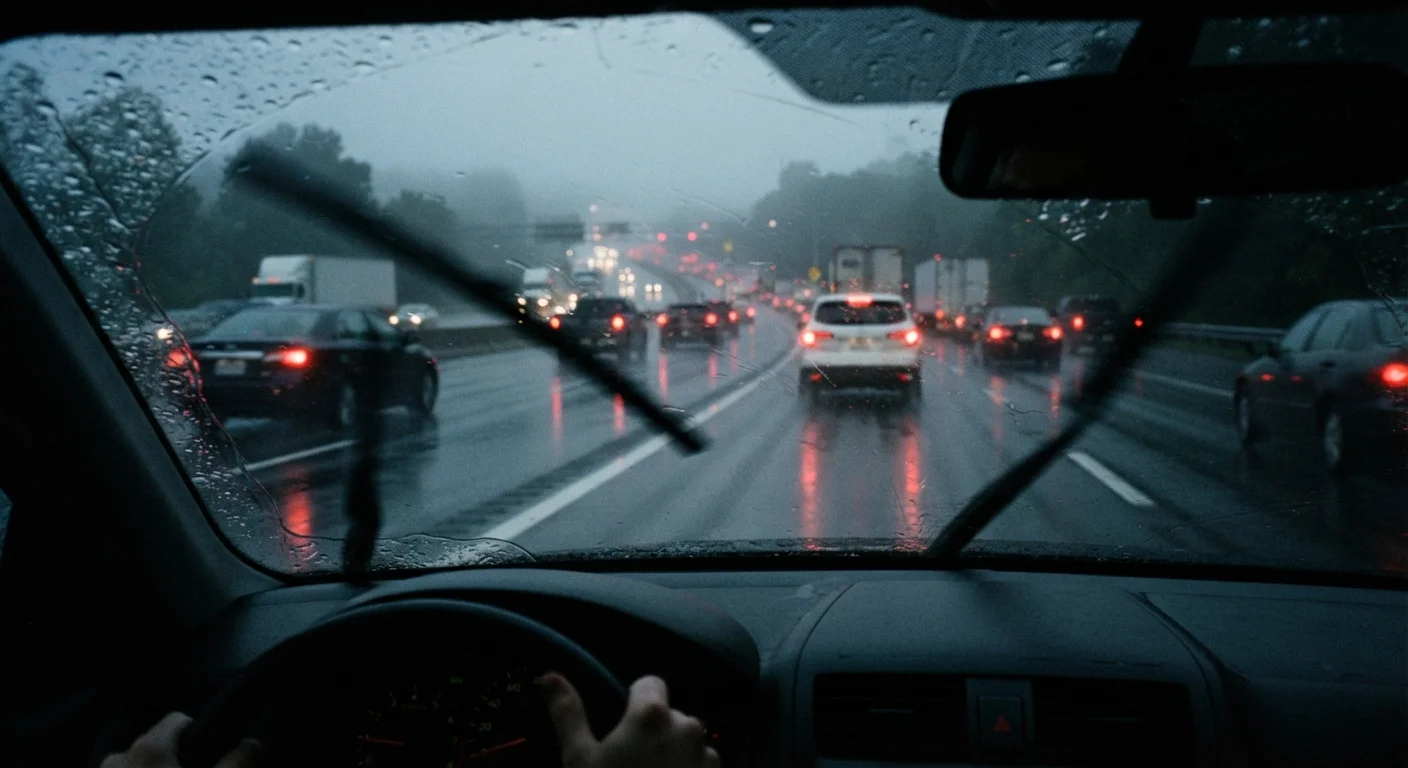
Why Poor Weather Exposes Everyday Driving Habits
Most drivers develop their habits in dry, familiar conditions — and those habits travel with them into rain, fog, and ice. The problem is that the physics of driving change substantially when traction, visibility, and road temperature shift. What works on a clear, dry road can become dangerous when the surface is wet or frozen.
Poor weather doesn't just demand slower speeds; it demands a fundamentally different mindset. Research from the Federal Highway Administration (FHWA) consistently identifies adverse weather as a significant factor in road crashes — with wet pavement and rain accounting for the majority of weather-related incidents. Understanding where drivers typically go wrong is the first step to doing better.
Night driving shares similar challenges — reduced visibility and slower reaction time — and many of the same habits that hurt drivers in darkness also apply in poor weather.
The Most Common Mistakes Drivers Make in Rain, Fog, and Ice
The errors below range from subtle misjudgements to outright dangerous assumptions. Each one is common precisely because it feels logical in the moment — until conditions turn critical.
Driving at normal speed in heavy rain because the road 'looks fine.'
Why it happens: Drivers rely on visual cues to judge grip, but water on the road surface dramatically reduces tire traction in ways the eye cannot detect.
Using high-beam headlights in fog to see further ahead.
Why it happens: The instinct to switch on full beams in low visibility is natural, but fog scatters high-beam light back toward the driver, making visibility worse rather than better.
Assuming all-wheel drive (AWD) or four-wheel drive (4WD) provides protection on ice.
Why it happens: AWD and 4WD systems improve traction during acceleration, which drivers often mistake for improved braking and cornering capability on ice.
Braking hard or steering sharply when the vehicle begins to slide.
Why it happens: A skid triggers a panic response, and the natural reaction is to grab the wheel and stamp on the brakes — both of which typically make a skid worse.
Driving in fog at a speed that makes it impossible to stop within visible distance.
Why it happens: Drivers often misjudge their speed relative to visibility because fog creates a false sense of slow movement, a well-documented phenomenon sometimes called 'fog hypnosis.'
Not adjusting tire pressure or checking tread depth before winter driving.
Why it happens: Drivers often treat tire checks as optional or seasonal tasks rather than recognising how directly tire condition affects wet and icy road performance.
Black Ice Offers No Visual Warning
Black ice looks like ordinary wet pavement and can form when air temperatures are as high as 39°F (4°C), particularly on bridges, overpasses, and shaded stretches. If your car suddenly feels unusually quiet or your steering goes light, you may already be on it. Ease off the accelerator gently — do not brake or steer sharply.
Taken together, these mistakes reflect a broader pattern: drivers treating poor weather as a minor inconvenience rather than a genuine change in driving conditions. Slowing down, increasing distance, and adapting to what your eyes and tyres are actually telling you can meaningfully reduce risk.
Preparing Your Vehicle — Not Just Your Driving
Safe driving in adverse conditions starts before you turn the ignition. A vehicle with worn wiper blades, under-inflated tires, or failing headlights is already compromised before rain or ice enters the picture.
~21%
Weather-related crash share on US roads
The Federal Highway Administration estimates that roughly 21% of all vehicle crashes in the US are weather-related, with wet pavement involved in the largest proportion.
2×+
Increase in stopping distance on wet roads
Stopping distances on wet roads can more than double compared to dry conditions at equivalent speeds, according to general road safety guidance.
39°F
Temperature at which black ice can form
Black ice can develop at air temperatures up to approximately 39°F (4°C), particularly on bridges, overpasses, and shaded road sections.
Checking your tires, lights, and wipers as seasons change is one of the simplest things you can do to reduce weather-related risk. Our guide on seasonal car maintenance walks through the key checks to run as conditions change. If a dashboard warning light appears before or during a journey, don't ignore it — see what your warning lights are actually telling you to understand what action is needed.
Poor weather also amplifies the impact of dangerous habits like tailgating that are risky even in dry conditions. A following distance that felt adequate in summer can become dangerously short when the road is wet or icy.
If an incident does occur despite your precautions, knowing what to do in the first 60 seconds after a road incident can make a significant difference to everyone involved.
Don't Rely Solely on Your Vehicle's Safety Systems
Electronic stability control (ESC), ABS, and traction control are valuable aids, but they have physical limits. On ice or heavily flooded roads, no system can overcome the fundamental loss of grip. These technologies reduce risk — they do not eliminate it. Adjust your speed and following distance regardless of what safety features your vehicle has.
The content provided on our blog site traverses numerous categories, offering readers valuable and practical information. Readers can use the editorial team’s research and data to gain more insights into their topics of interest. However, they are requested not to treat the articles as conclusive. The website team cannot be held responsible for differences in data or inaccuracies found across other platforms. Please also note that the site might also miss out on various schemes and offers available that the readers may find more beneficial than the ones we cover.