

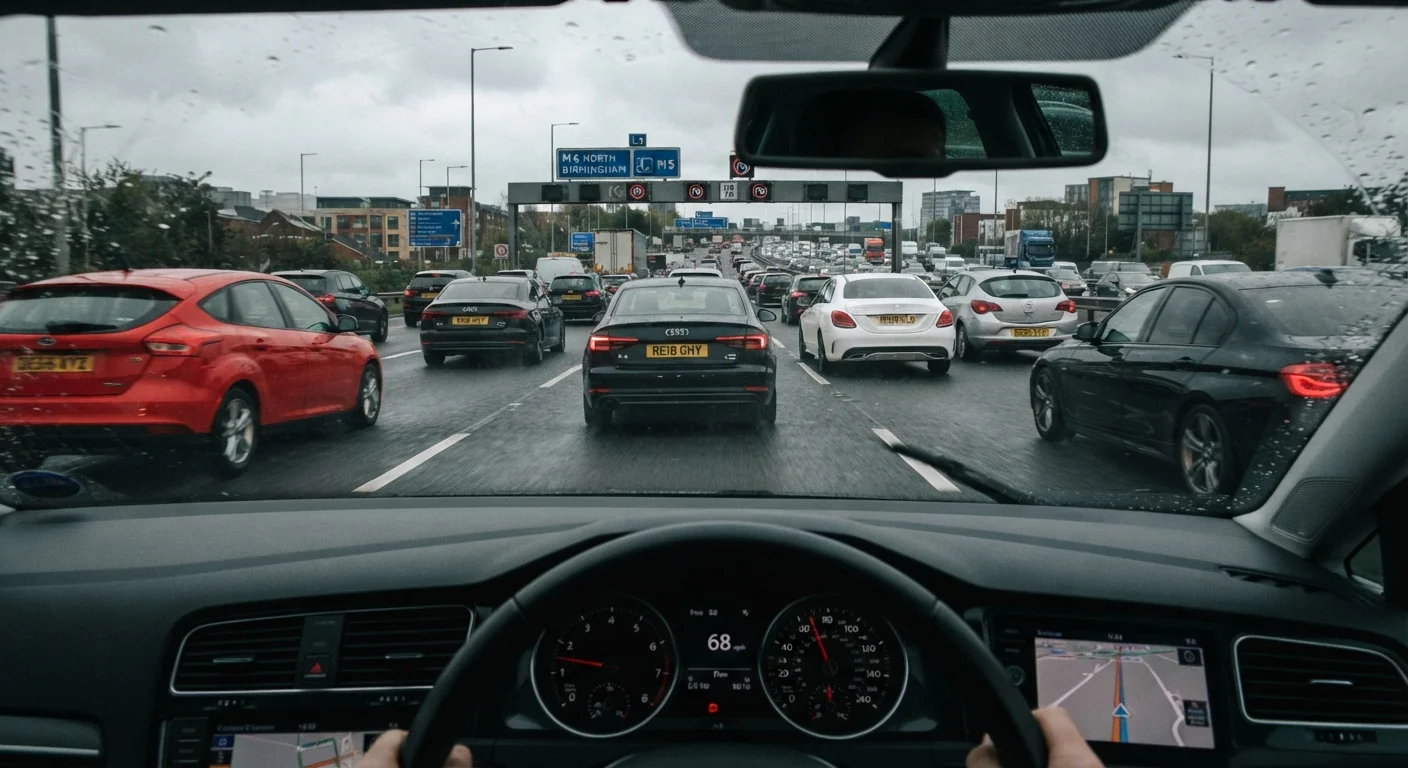
Why These Three Habits Are More Dangerous Than They Look
Motorway driving can feel deceptively routine. Speeds are relatively consistent, junctions are spaced far apart, and the road surface is typically well maintained. Yet motorways remain among the most hazardous environments for serious collisions — partly because three deeply ingrained driver habits quietly undermine safety at high speed: tailgating, undertaking, and middle-lane hogging.
What makes these behaviours particularly problematic is that many drivers who engage in them don't recognise the risk they're creating. Tailgating can feel like simply keeping up with traffic. Passing on the left seems efficient when the driver ahead won't move over. Sitting in the middle lane feels comfortable and "out of the way." None of these instincts hold up under scrutiny — and all three can contribute directly to crashes.
Understanding what each habit actually does to traffic dynamics — and to your own stopping distances — is the first step toward driving more safely and confidently. For a broader look at how rules and expectations shift depending on road type, see our guide on motorway, dual carriageway, and A-road differences.
Tailgating: The Habit That Eliminates Your Safety Margin
Tailgating — following the vehicle ahead too closely — is one of the most common precursors to rear-end collisions. At 70 mph, a car covers roughly 102 feet per second. The Highway Code recommends at least a two-second gap in dry conditions, which at motorway speed translates to over 200 feet of space. Most tailgating drivers leave a fraction of that.
The danger isn't just about stopping distance. When drivers follow too closely, they lose visibility of hazards further up the road and reduce their ability to respond to anything other than the immediate vehicle ahead. A sudden brake from the car in front — triggered by something the tailgater can't even see — leaves no time to react.
Tailgating also has a psychological trigger: many drivers unconsciously close the gap when they feel impatient or when traffic ahead seems to be moving inconsistently. The fix is deliberate: pick a fixed marker on the road (a bridge, a road sign) and ensure the vehicle ahead clears it before you reach it. That two-second check takes almost no effort and preserves the margin you need.
At 70 mph, closing the gap by just a few car lengths can eliminate your entire stopping margin.
Undertaking: Why Passing on the Left Creates Blind-Spot Collisions
Undertaking — overtaking a vehicle on its left on a motorway or dual carriageway — is illegal in most circumstances under UK law. The reason isn't bureaucratic: it's that most drivers don't expect to be passed on the left, and many vehicles' blind spots are more pronounced on that side.
When a driver in a middle or outer lane is undertaken, they may be in the process of checking right before moving left — the direction you're approaching from. The result is a side-swipe collision that neither driver anticipated. Because undertaking often happens at higher relative speeds than conventional overtaking, the impact when things go wrong tends to be severe.
The root cause is usually a combination of impatience and frustration with a middle-lane hogger or slow left-lane merger. The appropriate response is to maintain a safe following distance and, where safe and legal, signal and overtake on the right. If the driver ahead is genuinely blocking traffic improperly, that is a matter for enforcement — not for a risky manoeuvre on their left.
Undertaking exploits the exact blind spot most drivers are least prepared to check at speed.
Middle-Lane Hogging: How One Driver Can Disrupt an Entire Motorway
Middle-lane hogging occurs when a driver occupies the centre lane of a three-lane motorway unnecessarily — typically when the left lane is clear and there is no overtaking manoeuvre in progress. It became an endorsable offence in the UK in 2013, carrying a fixed penalty and points, though enforcement remains inconsistent.
The traffic engineering problem it creates is significant. A middle-lane hogger effectively removes one usable lane from the motorway. Drivers in the right lane wanting to return left are blocked, so they either remain in the outer lane longer than necessary or must pass across two lanes. This ripples back through traffic, compressing gaps and increasing the frequency of abrupt lane changes.
Middle-lane hogging often stems from anxiety about the left lane — concerns about merging vehicles from slip roads, or simply an unfamiliarity with the keep-left rule. In practice, the left lane is the safest default position: it gives you more options, keeps the road predictable for everyone around you, and requires no special judgement call about when to move back over.
One driver sitting in the middle lane can compress traffic flow across an entire motorway stretch.
Building Safer Habits Starts With Awareness
None of these three habits requires advanced skill to correct — they require attention, honesty about your own driving patterns, and a willingness to adjust. The two-second rule for following distance is a reliable baseline in dry conditions; in wet or icy weather, that gap should at least double. For more on how conditions affect safe driving, the article driving in rain, fog, and ice covers the misjudgements that catch drivers out.
Lane discipline is equally straightforward in principle: use the left lane as your default, move right only to overtake, then return promptly. The discomfort some drivers feel in the left lane — particularly near slip roads or slower vehicles — is manageable with practice and tends to diminish quickly once the habit forms.
Practice the Two-Second Rule Actively
Don't assume you're leaving enough space — check it deliberately on every motorway trip. Choose a fixed roadside marker and count "one-thousand-one, one-thousand-two" after the vehicle ahead passes it. If you reach the marker before finishing the count, you're too close. In wet weather, double the gap.
It's also worth remembering that road behaviour doesn't exist in isolation. A well-maintained vehicle with properly adjusted mirrors, functional lights, and correct tyre pressure makes hazard recognition and response significantly more reliable. Our pre-drive safety check outlines what to look for before setting off.
Changing these habits won't make journeys longer or more difficult. In practice, consistent lane discipline and appropriate following distances tend to reduce driver stress, smooth traffic flow, and lower the likelihood of being caught in the kind of sudden braking scenario that causes pile-ups. Safer driving here is also, genuinely, calmer driving.
The content provided on our blog site traverses numerous categories, offering readers valuable and practical information. Readers can use the editorial team’s research and data to gain more insights into their topics of interest. However, they are requested not to treat the articles as conclusive. The website team cannot be held responsible for differences in data or inaccuracies found across other platforms. Please also note that the site might also miss out on various schemes and offers available that the readers may find more beneficial than the ones we cover.