

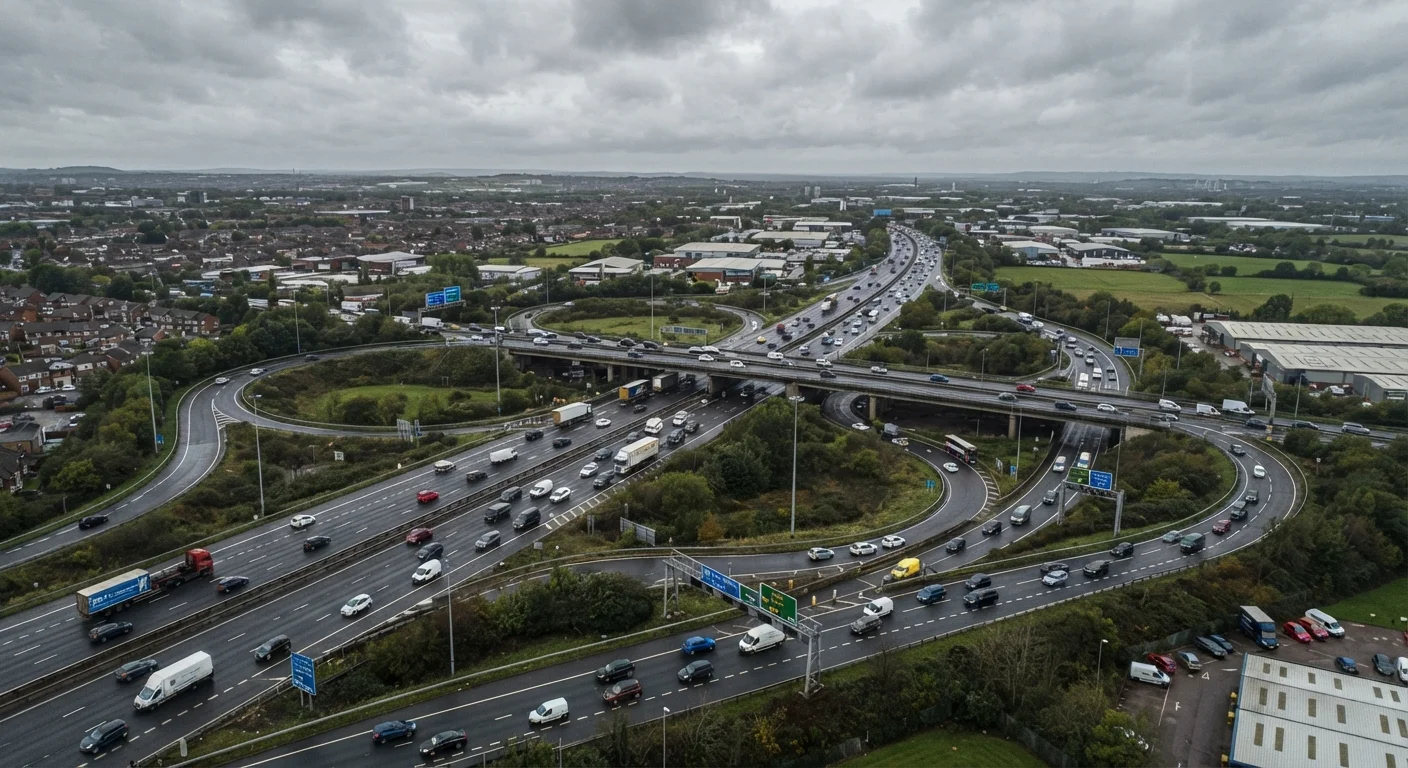
Why Road Type Matters More Than Most Drivers Realise
Many drivers operate under a rough-and-ready sense of the rules, applying broadly similar habits across motorways, dual carriageways, and A-roads. In practice, however, the legal and practical requirements differ in ways that matter — from minimum speed expectations to who can use a road at all. Misunderstanding these differences is a common factor in unnecessary near-misses, fixed penalty notices, and motorway collisions.
| Motorway speed limit (cars) | 70 mph (national); lower if gantry-posted (UK Highway Code, Rule 262) |
| Dual carriageway speed limit (cars) | 70 mph national; local limits common (UK Highway Code, Rule 124) |
| Single A-road rural speed limit | 60 mph national limit applies by default (UK Highway Code, Rule 124) |
| Built-up area default limit | 30 mph where street lighting present (UK Highway Code, Rule 124) |
| Who can use a motorway | Cars, lorries, motorcycles 50cc+, and buses only (Motorways Traffic Regulations 1982) |
| Middle-lane hogging offence | Fixed penalty notice and 3 penalty points (UK Highway Code, Rule 264) |
The three main high-speed road categories in the UK each carry their own Highway Code obligations. Getting familiar with what changes — and what stays the same — is a straightforward way to become a safer, more confident driver. If you also drive in wet or low-visibility conditions, see our guide on driving safely in rain, fog, and ice, where road type further compounds the risks.
Motorways: Highest-Speed, Most Regulated
Motorways (designated M-roads) are designed exclusively for fast-moving traffic and carry the most restrictions on who may use them. Pedestrians, cyclists, motorcycles under 50cc, mobility scooters, horse riders, and agricultural vehicles are all prohibited. This makes motorways categorically different from all other UK roads.
National speed limit
The default maximum speed set by law when no other limit is posted. On motorways and dual carriageways this is 70 mph for cars; on single carriageways it is 60 mph. It is indicated by a white circular sign with a diagonal black stripe.
Smart motorway
A motorway where technology manages traffic flow, sometimes by converting the hard shoulder into a live running lane. Variable speed limits shown on overhead gantries are legally enforceable.
Grade-separated junction
A junction where roads cross at different levels using bridges or underpasses, eliminating direct conflict between traffic streams. All motorway junctions are grade-separated; slip roads connect to the main carriageway.
At-grade junction
A junction where roads meet on the same level, requiring drivers to give way, stop, or follow signal controls. Common on dual carriageways and A-roads; absent on motorways.
Central reservation
The physical barrier or strip dividing the two opposing carriageways of a dual carriageway or motorway. It prevents head-on collisions and defines the road as a dual carriageway rather than a single carriageway.
Variable speed limit
A legally enforceable speed limit displayed on overhead gantry signs rather than fixed roadside signs. Used primarily on smart motorways to manage congestion and incident risk.
Speed limit: The national speed limit on motorways is 70 mph for cars and motorcycles. Variable speed limits — displayed on overhead gantry signs — are legally enforceable and must be observed even when the road ahead appears clear. A blank gantry sign or a white circular sign with no number reinstates the national speed limit.
Lane discipline: Drivers must keep left unless overtaking. The middle and right lanes are for overtaking only — sitting in them when the left lane is clear is an offence under the Highway Code (Rule 264) and can result in a fixed penalty. For a deeper look at lane-related habits, our article on tailgating, undertaking, and middle-lane hogging explains how these behaviours contribute to crashes.
Junctions: Motorway junctions are always grade-separated (accessed via slip roads). U-turns and reversing on a motorway are illegal. On smart motorways, the hard shoulder may operate as a live running lane — check the overhead signs before using it.
Dual Carriageways: Often Confused With Motorways
A dual carriageway has two separate carriageways divided by a central reservation, but it is not a motorway. The most significant practical difference: dual carriageways are open to all road users, including cyclists, agricultural vehicles, and slower-moving traffic. Drivers must account for this, particularly when joining or leaving the road.
~56%
Of fatal crashes occurring on rural roads
UK Department for Transport road casualty data consistently shows rural roads — including A-roads — account for the majority of fatal collisions despite lower traffic volumes.
70 mph
Maximum legal speed on motorways and dual carriageways
This limit has remained unchanged in the UK since 1965 and applies to cars and motorcycles on both road types.
3 points
Penalty for middle-lane hogging
Since 2013, careless driving offences including middle-lane hogging carry a fixed penalty of a fine and three penalty points on the driver's licence.
Speed limit: The national speed limit on a dual carriageway is 70 mph for cars — the same as a motorway. However, lower local limits are common and must be obeyed. Always look for signs; the absence of a repeater sign does not automatically confirm the national limit applies.
Junctions: Unlike motorways, dual carriageways may have at-grade junctions — meaning traffic can cross, turn right, or pull out directly from side roads. This significantly increases the risk of conflict, especially at high speeds. Approach junctions with greater caution than on a motorway.
Lane discipline: The same keep-left principle applies. On dual carriageways with more than two lanes per carriageway, the Highway Code rules on overtaking lanes still apply.
A-Roads: The Most Variable Category
A-roads vary enormously in character. Some are wide, fast, and practically indistinguishable from a dual carriageway. Others pass through towns and villages with 30 mph limits, pedestrian crossings, and junction priorities that change every few hundred metres. This variability is precisely what makes A-roads the most demanding road type for consistent judgement.
Local Limits Override the National Default
Even on roads where the national speed limit would normally apply, local authorities can — and frequently do — impose lower limits through posted signs. A common misconception is that the absence of repeater signs means the national limit applies; this is only reliably true once you've confirmed the last signed limit. When in doubt, match your speed to the character of the road and posted signage, and check for any entry-point signs when joining a new stretch of road.
Speed limit: Single-carriageway A-roads default to 60 mph national speed limit in rural areas, but local limits are extremely common. Always observe posted signs. In built-up areas — typically indicated by street lighting — the default limit drops to 30 mph unless signs say otherwise.
Junctions: A-roads use a full range of junction types: roundabouts, traffic lights, give-way lines, and unmarked junctions. Priority rules at each must be applied correctly. At unmarked junctions (no lines, no signs), the Highway Code advises equal priority — but in practice, extra caution is essential.
Road users: All road users are permitted on A-roads. Expect cyclists, farm vehicles, motorcycles, and pedestrians — particularly outside urban areas where footways may be absent entirely.
Key Differences at a Glance
| Rule / Feature | Motorway | Dual Carriageway | Single A-Road |
|---|---|---|---|
| Default speed limit (cars) | 70 mph | 70 mph | 60 mph (rural) |
| Cyclists permitted | No | Yes | Yes |
| At-grade junctions | No | Sometimes | Yes, frequently |
| Lane discipline rules | Strict keep-left | Keep-left | Keep-left where applicable |
| Variable speed limits | Common (smart motorways) | Occasional | Rare |
| U-turns permitted | No | Where safe and legal | Where safe and legal |
Refreshing your knowledge of the Highway Code across road types costs nothing but pays off every time you drive. Whether you're navigating a busy M-road interchange or turning onto an unfamiliar A-road, the rules exist to keep every road user safer.
The content provided on our blog site traverses numerous categories, offering readers valuable and practical information. Readers can use the editorial team’s research and data to gain more insights into their topics of interest. However, they are requested not to treat the articles as conclusive. The website team cannot be held responsible for differences in data or inaccuracies found across other platforms. Please also note that the site might also miss out on various schemes and offers available that the readers may find more beneficial than the ones we cover.