

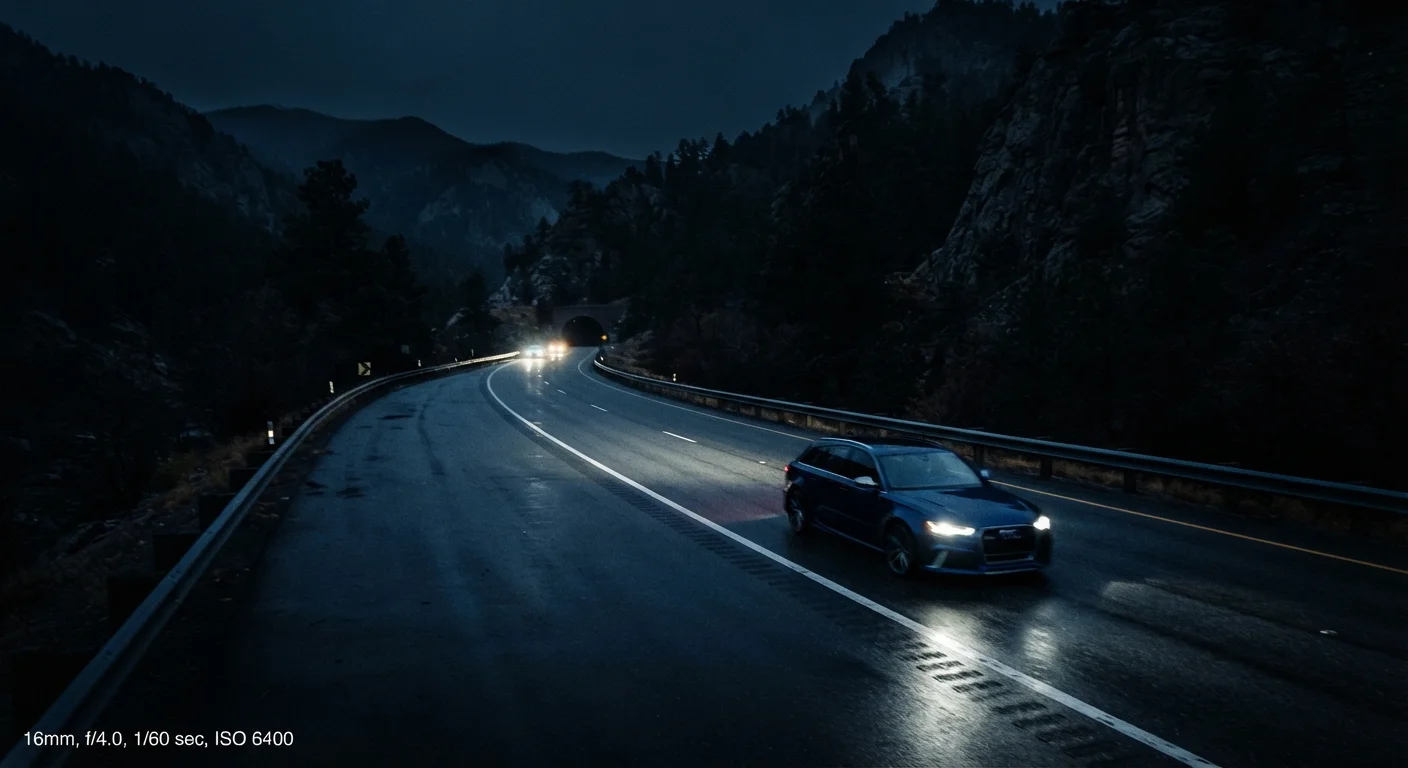
The Numbers Behind Night Driving Danger
It's easy to assume night driving is safer simply because fewer cars are on the road. The data tells a different story. According to the National Highway Traffic Safety Administration (NHTSA), roughly half of all traffic fatalities in the United States occur at night, despite nighttime representing a much smaller share of total miles driven.
That gap between lower traffic volume and higher fatality rates reveals an uncomfortable truth: darkness doesn't just reduce visibility — it fundamentally changes the nature of the driving task in ways that most drivers underestimate. Speed misjudgment, missed pedestrians, and delayed hazard detection all become more likely once the sun goes down.
~50%
Of US traffic fatalities occur at night
According to NHTSA data, roughly half of all fatal crashes happen during nighttime hours despite significantly lower traffic volumes.
160–250 ft
Typical low-beam headlight range
Most standard low-beam headlights illuminate between 160 and 250 feet of road ahead, which can be less than the stopping distance needed at highway speeds.
3x
Higher pedestrian fatality risk at night
NHTSA research indicates pedestrians are roughly three times more likely to be killed in traffic incidents at night than during daylight hours.
Understanding the specific reasons night driving is harder — not just accepting that it is — puts you in a much stronger position to manage those risks.
How Darkness Limits What Your Eyes Can Do
Human vision is not well suited to low-light environments when driving is involved. In daylight, your eyes use cone cells concentrated in the center of your retina to deliver sharp, color-accurate detail. At night, your visual system shifts toward rod cells, which are spread across the periphery of the retina and are more sensitive to light, but slower to process contrast and motion.
The practical effect: your ability to accurately judge the speed and distance of other vehicles deteriorates. Pedestrians wearing dark clothing can become nearly invisible until they are dangerously close. Road markings, potholes, and debris that would be obvious in daylight may not register until your headlights are almost on top of them.
Night Vision Declines With Age
Drivers over 50 often notice a meaningful reduction in their ability to see clearly in low-light conditions. This is largely due to the gradual loss of pupil dilation efficiency and increased lens cloudiness that comes with aging. Annual eye examinations and appropriate corrective lenses can partially offset these changes, but they can't eliminate them entirely.
Older drivers are particularly affected. The pupil's ability to dilate and gather light diminishes with age, meaning a 60-year-old driver may need significantly more light to see the same level of detail as a 30-year-old. Regular eye examinations are an underrated part of night driving preparation.
Headlight Glare and the Temporary Blindness Problem
One of the most acute hazards of night driving is something every driver experiences but rarely thinks about strategically: glare from oncoming headlights. When a bright light source enters your field of vision in an otherwise dark environment, your eyes require time to readjust — a process called dark adaptation that can take anywhere from a few seconds to several minutes depending on intensity.
Even a brief moment of significant vision impairment at highway speed covers substantial ground. A driver traveling at 65 mph who experiences two to three seconds of glare-related vision loss covers over 190 feet — more than half the length of a standard football field — while effectively unable to see clearly.
Manage Glare Proactively
When oncoming headlights are bright, shift your gaze to the right edge of the road or the painted lane line rather than looking directly into the light source. This preserves your directional awareness while reducing the intensity of the glare hitting your eyes. Slightly reducing your speed during the approach gives you extra time to recover full vision before any hazard could appear.
Poorly aimed or excessively bright aftermarket headlights on other vehicles have made this problem worse on US roads in recent years, and it's a known concern among road safety researchers. Until infrastructure and regulation catch up, individual driver awareness remains the primary defense. Also compare how nighttime challenges overlap with other low-visibility conditions — see our guide on driving in rain, fog, and ice for a broader picture.
Fatigue: The Silent Multiplier
Fatigue and darkness are a particularly dangerous combination. The human body's circadian rhythm — its internal biological clock — promotes sleepiness in the hours between midnight and 6 a.m. Driving during this window dramatically increases the likelihood of microsleeps: brief, involuntary lapses in consciousness lasting one to several seconds that the driver often cannot detect or remember.
What makes fatigue especially insidious is that impaired drivers consistently overestimate their own alertness. Unlike alcohol, which produces noticeable physical cues, fatigue tends to creep in gradually and distort self-assessment. Behaviors that increase night crash risk — such as tailgating and poor lane discipline — become more likely when a driver is tired, even if they don't feel it.
“Drowsy driving is a serious problem that can be as dangerous as drunk driving. Drivers often don't recognise when they are too impaired to drive safely.”
— National Highway Traffic Safety Administration, US federal road safety agency
The most reliable countermeasure is also the simplest: don't drive when you're meaningfully sleep-deprived. On longer nighttime journeys, plan breaks every two hours, and recognise warning signs like yawning frequently, difficulty keeping eyes open, or drifting from your lane.
Practical Steps That Actually Make a Difference
Awareness of night driving risks is only useful if it translates into different behavior. Several straightforward habits measurably reduce your exposure to nighttime hazards:
- Slow down: Speed must match your actual sight distance, not the posted limit. If your headlights reveal 200 feet of road, that's the distance in which you need to stop — not the length of your stopping distance at your current speed.
- Keep lights and glass clean: Dirty headlights can reduce illumination by up to 90%. A clean windshield eliminates the scatter and halos that dirty glass creates around light sources. Our pre-drive safety checklist covers what to inspect before any journey.
- Increase following distance: The two-second rule used in daylight is a minimum. At night, three to four seconds gives you more time to respond to hazards your headlights reveal late.
- Use high beams strategically: On unlit roads with no oncoming traffic, high beams can double your sight distance. Switch back to low beams when another vehicle is within roughly 500 feet.
Night driving will always carry greater inherent risk than driving in daylight. But drivers who understand why — and who adjust their behavior accordingly — can substantially reduce that risk for themselves and everyone sharing the road.
Frequently Asked Questions
Darkness limits how far and how clearly you can see the road, pedestrians, and other hazards. Compounding this, headlight glare from oncoming vehicles can temporarily blind you, and fatigue is more likely to set in after dark. Together, these factors reduce reaction time and increase crash severity.
Standard low-beam headlights illuminate roughly 160 to 250 feet ahead. At 60 mph, a vehicle travels approximately 88 feet per second, meaning you have only about two to three seconds of visible stopping distance — often less than you need in an emergency.
Avoid staring directly into oncoming headlights. Instead, shift your gaze toward the right edge of the road or lane markings to maintain your path. Slow down slightly until your vision fully recovers, which can take several seconds.
Research from multiple road safety organizations suggests that severe sleep deprivation can impair driving ability to a degree comparable to legal alcohol intoxication. If you feel drowsy, pulling over in a safe location and resting is the responsible choice.
Keep your headlights, taillights, and windshield clean and in proper working order. Reduce your speed to match your actual sight distance. Take breaks on long nighttime trips, and have your eyes checked regularly — uncorrected vision problems worsen dramatically in low light.
Adaptive headlights, LED systems, and automatic high-beam assist can extend and improve the range and quality of illumination. However, poorly aimed headlights — regardless of technology — can create glare for other drivers. Regular alignment checks are important.
The content provided on our blog site traverses numerous categories, offering readers valuable and practical information. Readers can use the editorial team’s research and data to gain more insights into their topics of interest. However, they are requested not to treat the articles as conclusive. The website team cannot be held responsible for differences in data or inaccuracies found across other platforms. Please also note that the site might also miss out on various schemes and offers available that the readers may find more beneficial than the ones we cover.