

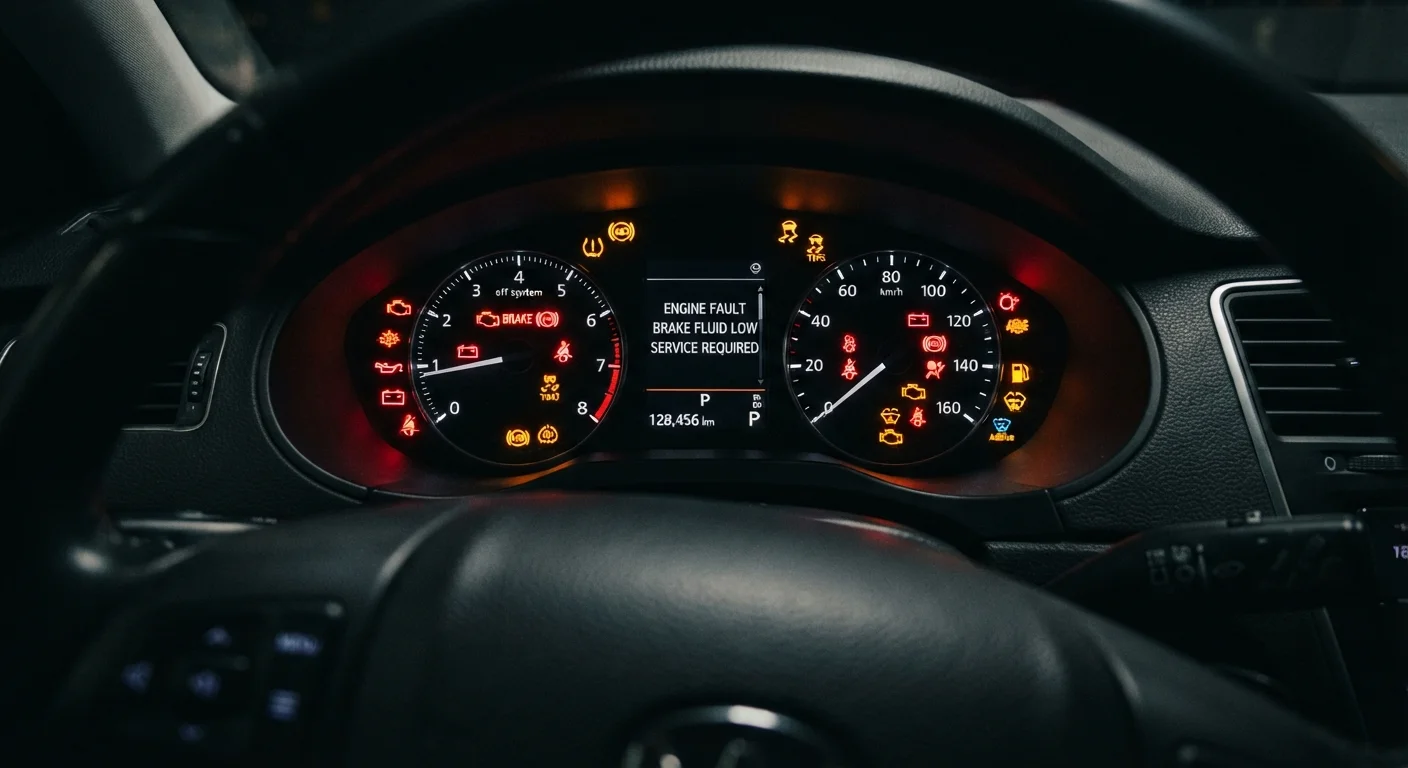
Why Warning Lights Exist — and Why They Matter
Modern vehicles rely on an onboard diagnostics system (OBD) that continuously monitors dozens of sensors throughout your car. When a sensor detects a reading outside of normal parameters, it triggers an illuminated symbol on your dashboard — a warning light. These signals range from routine reminders to urgent alerts that demand immediate attention.
Ignoring a warning light — or assuming it will resolve on its own — is one of the most common and costly mistakes drivers make. A light that seems minor can signal a developing problem that, left unchecked, leads to serious mechanical failure or a safety risk on the road. Understanding what each symbol means is a fundamental part of responsible car ownership.
As part of your overall vehicle awareness, it helps to pair this knowledge with a broader routine — see our pre-drive safety check for habits that catch problems before they escalate.
| Number of OBD sensors monitored | Dozens of systems simultaneously (General OBD-II standard, applicable to US vehicles from 1996 onward) |
| When OBD-II became mandatory in the US | 1996 (all new passenger vehicles) (US Environmental Protection Agency mandate) |
| Red light urgency | Stop or act immediately |
| Amber/yellow light urgency | Schedule service within days to a week |
| Most common warning light reported | Check Engine (MIL) (Commonly cited by automotive service industry surveys) |
The Most Common Warning Lights Decoded
Not all warning lights carry the same urgency. A helpful way to think about them: red means stop or act now, yellow/amber means investigate soon, and green or blue means a system is active (not a warning at all).
OBD (Onboard Diagnostics)
A standardized system built into modern vehicles that monitors engine, emissions, and other systems. When a fault is detected, it stores a diagnostic trouble code (DTC) and may trigger a warning light.
MIL (Malfunction Indicator Lamp)
The technical name for the check engine light. It illuminates when the OBD system detects an emissions- or engine-related fault that needs attention.
TPMS (Tire Pressure Monitoring System)
A sensor-based system that monitors the air pressure in each tire and alerts the driver when pressure falls below a safe threshold, typically via an amber dashboard light.
Catalytic Converter
An emissions control device in the exhaust system that converts harmful combustion byproducts into less harmful gases. It can be damaged by engine misfires or overheating.
Diagnostic Trouble Code (DTC)
A standardized alphanumeric code stored by the OBD system when a fault is detected. A mechanic or scan tool can retrieve these codes to pinpoint what triggered a warning light.
Red Lights: Do Not Ignore
- Oil Pressure Warning: Pull over safely as soon as possible and turn off the engine. Low oil pressure can cause catastrophic engine damage within minutes of driving.
- Engine Temperature (Coolant Temp): Your engine is overheating. Stop driving, let the engine cool, and check coolant levels — never open the radiator cap on a hot engine.
- Battery Warning: Your charging system is failing. You may have limited driving time before the car loses power entirely. Head directly to a mechanic.
- Brake System Warning: Could indicate low brake fluid, a brake failure, or simply the parking brake being engaged. If the parking brake is off, treat this as urgent.
Amber/Yellow Lights: Investigate Promptly
- Check Engine (MIL): The malfunction indicator lamp can signal anything from a loose gas cap to a misfiring cylinder. A steady light means schedule service soon; a flashing light means pull over — a misfire can damage your catalytic converter.
- Tire Pressure (TPMS): One or more tires are significantly under- or over-inflated. Check pressures before continuing to drive.
- Traction Control / Stability Control: If illuminated while driving, the system is actively working. If it stays on without intervention, it may be disabled or faulty.
- Transmission Temperature: The transmission fluid is overheating. Ease off heavy loads and have it inspected.
For a broader picture of how service timing connects to these alerts, routine maintenance timelines explains how overlooked service intervals often lead to warning lights appearing in the first place.
Your Owner's Manual Is the Definitive Reference
Dashboard symbols are not entirely standardized across all manufacturers. Some automakers use proprietary icons or color conventions that differ from general guidance. Always cross-reference any unfamiliar warning light with your vehicle's owner's manual before deciding on a course of action. If you no longer have your manual, most automakers make digital versions available through their official websites.
When to Pull Over Immediately vs. When You Can Drive On
The decision to keep driving or stop depends on the specific light and your current situation. Use this as a general framework:
| Warning Light | Action |
|---|---|
| Oil Pressure (red) | Stop immediately — engine damage risk is high |
| Engine Temperature (red) | Stop safely — allow cooling before opening hood |
| Brake System (red) | Stop if braking feels abnormal; verify parking brake first |
| Check Engine — flashing | Pull over; avoid high RPMs |
| Check Engine — steady | Drive to a shop within a few days |
| TPMS (amber) | Check pressures at next opportunity; avoid highway speeds |
| Battery (red) | Drive directly to a mechanic without delay |
Always consult your vehicle's owner manual, as symbols and their meanings can vary by make and model. If you're ever uncertain, err on the side of caution and have the vehicle inspected. Safe driving in any condition — including handling unexpected mechanical issues — requires staying calm and aware; our safe driving hub offers further guidance on handling on-road situations confidently.
1 in 3
Drivers who ignore a warning light for over a week
Industry surveys consistently find a significant share of drivers delay responding to dashboard alerts, often leading to more expensive repairs.
~$400–$600
Average cost of a catalytic converter repair caused by misfires
Driving with a flashing check engine light — often indicating a misfire — is a leading cause of preventable catalytic converter damage, according to automotive repair estimates.
The content provided on our blog site traverses numerous categories, offering readers valuable and practical information. Readers can use the editorial team’s research and data to gain more insights into their topics of interest. However, they are requested not to treat the articles as conclusive. The website team cannot be held responsible for differences in data or inaccuracies found across other platforms. Please also note that the site might also miss out on various schemes and offers available that the readers may find more beneficial than the ones we cover.