

Why Tyre Maintenance Is a Safety Issue, Not Just a Cost Issue
Tyres are the only part of your vehicle in contact with the road. Everything else — brakes, steering, suspension — depends on four palm-sized patches of rubber doing their job reliably. When tyres are under-inflated, excessively worn, or unevenly loaded, stopping distances increase, handling deteriorates, and the risk of a blowout rises. The National Highway Traffic Safety Administration (NHTSA) has documented thousands of tyre-related crashes annually in the US, the majority of which involve preventable conditions such as low pressure or insufficient tread depth.
The good news is that tyre maintenance is straightforward, requires no specialist tools, and takes only minutes when done regularly. Whether you're a first-time owner — see our guide for new drivers — or a seasoned motorist brushing up on fundamentals, understanding pressure, tread, and rotation is among the highest-value habits you can develop.
2/32"
US minimum legal tread depth
Federal Motor Vehicle Safety Standards set this as the floor; safety advocates recommend planning replacement at 4/32".
1 PSI
Pressure drop per 10°F temperature fall
A widely cited rule of thumb from tyre industry guidance, highlighting why winter pressure checks matter.
~11,000
Tyre-related crashes reported annually (US)
Based on NHTSA data, the majority involve preventable conditions such as under-inflation or worn tread.
Tyre Pressure: The Numbers You Need to Know
Correct tyre pressure is specified by the vehicle manufacturer, not the tyre maker. You'll find it on a sticker inside the driver's door jamb (the door placard) or in your owner's manual. This figure is expressed in PSI (pounds per square inch) and represents the cold inflation pressure — meaning the tyre has been sitting for at least three hours or driven fewer than a mile. Never use the maximum PSI printed on the tyre sidewall; that is the tyre's structural limit, not the recommended operating pressure.
A common and useful rule of thumb: tyre pressure drops approximately 1 PSI for every 10°F decrease in ambient temperature. This means a tyre properly inflated in summer may be 5–8 PSI low by mid-winter without a single slow leak. This matters most in autumn — a reason tyre pressure features in seasonal maintenance checklists for good reason.
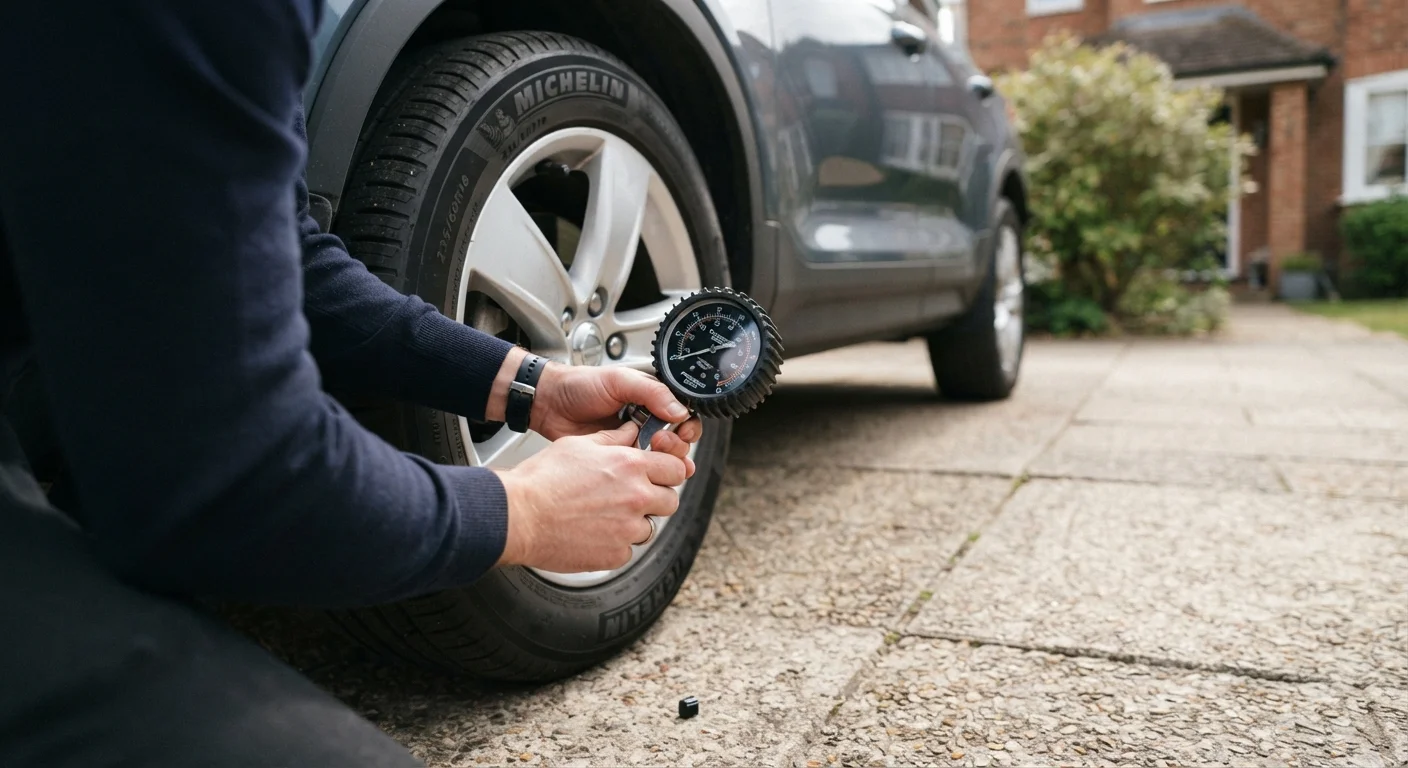
Check tyre pressure first thing in the morning before driving anywhere — even a short trip to a gas station warms the air inside the tyre and gives you a slightly elevated reading that can mask a developing problem.
Cold-inflation pressure is the standard measurement reference; driving even a mile raises tyre temperature and internal air pressure by several PSI, making it harder to assess true baseline condition.
Keep a dedicated digital tyre gauge in your glove box rather than relying on forecourt air hoses, which are often poorly calibrated.
Accurate pressure readings depend on a reliable gauge; inexpensive stick-type or digital gauges available at auto-parts stores have been shown in independent tests to be more consistently accurate than public-use equipment.
Many modern vehicles include a TPMS dashboard warning light, but that light typically triggers only when pressure drops 25% or more below recommended levels — well into unsafe territory. Relying solely on TPMS is not a substitute for monthly manual checks with a quality gauge.
Don't Rely Solely on Your TPMS Warning Light
TPMS alerts are designed to catch seriously low pressure — typically 25% below recommended — not gradual, moderate losses. By the time the light illuminates, the tyre has likely been operating in an unsafe condition for some time. Monthly manual checks with a gauge are still necessary even on vehicles with TPMS.
Reading Tread Wear and Knowing When Tyres Are Unsafe
Tread depth is measured in 32nds of an inch in the US. New passenger tyres generally start with 10/32" to 11/32" of tread. Federal law prohibits using tyres worn below 2/32", but independent tyre safety research — including tests conducted by the Tire Rack and referenced by NHTSA — consistently shows that wet-road stopping performance degrades significantly before that legal threshold, particularly below 4/32".
The quickest field check is the quarter test: insert a US quarter into the tread groove with Washington's head pointing down. If you can see the top of his head, the tread is at or below 4/32" and replacement should be planned. The penny test (2/32" threshold) tells you only that the tyre is already at the legal limit.
Use the Quarter Test as Your Default Check
The US quarter coin gives you the 4/32" benchmark most safety professionals consider the practical replacement threshold. Carry one in your glove box and make it part of every monthly tyre inspection. If any single groove fails the test, it's time to consult a tyre professional — don't wait until all grooves are at that level.
Look also for these patterns of uneven wear, which indicate underlying mechanical issues:
- Center wear only: Consistent over-inflation.
- Edge wear only (both sides): Consistent under-inflation.
- One-sided wear: Wheel misalignment or worn suspension components.
- Cupping or scalloping: Worn shock absorbers or struts.
If you observe any of these patterns, have the vehicle inspected by a qualified mechanic — replacing tyres without addressing the root cause means the new set will wear unevenly too.
Sidewall Bulges and Cracks Require Immediate Attention
A bulge in the tyre sidewall indicates internal structural damage — the tyre's carcass has failed and a blowout can occur at any time, especially at highway speeds. Similarly, deep cracking or crazing across the sidewall signals rubber degradation. Neither condition is repairable. If you observe either, have the vehicle inspected by a qualified technician before driving further where possible.
Tyre Rotation: Intervals, Patterns, and Why It Pays Off
Front and rear tyres wear at different rates because they perform different functions. Front tyres on front-wheel-drive vehicles steer and transmit drive force, causing them to wear roughly twice as fast as rears. Rotation redistributes this load so all four tyres wear at comparable rates, extending the life of the full set and maintaining balanced handling.
Most manufacturers and the Rubber Manufacturers Association recommend rotating tyres every 5,000 to 7,500 miles, though your owner's manual is the definitive source. Many drivers time rotation with every other oil change as a simple memory aid. This interval is also reviewed in our overview of maintenance timelines drivers often misjudge.
Common rotation patterns depend on drivetrain and tyre type:
- Forward cross: Fronts move straight back; rears cross to the opposite front. Standard on front-wheel-drive vehicles.
- Rearward cross: Rears move straight forward; fronts cross to the opposite rear. Common on rear- and all-wheel-drive vehicles.
- X-pattern: All four tyres swap diagonally. Used when wear imbalance is more pronounced.
Directional tyres (which have a one-way tread pattern) can only be rotated front-to-rear on the same side, not crossed. Staggered fitments (different widths front and rear) may require periodic side-to-side dismounting and remounting to achieve any rotation benefit — check with your tyre professional.
Staggered and Run-Flat Tyres Have Different Rules
Performance vehicles with staggered fitments (wider rear tyres than fronts) and some vehicles equipped with run-flat tyres may not support standard rotation patterns. Some run-flat manufacturers do not recommend rotation at all, while others have specific guidance. Always consult your owner's manual or a qualified tyre technician before rotating these tyre types.
Keep a record of each rotation with mileage noted. This is part of a broader service history practice covered in our guide to accurate service records.
Building Tyre Checks Into Your Regular Routine
The most effective approach is to make tyre checks automatic rather than reactive. A monthly pressure check — done when tyres are cold, before driving — catches gradual losses before they become safety hazards. This pairs naturally with the broader pre-drive safety check that takes just a few minutes before setting off.
A practical monthly routine includes:
- Check pressure in all four tyres (and the spare if applicable) using a reliable gauge.
- Visually inspect each tyre for cuts, bulges, embedded objects, or cracking sidewalls.
- Do a quick tread-depth check using a quarter.
- Note the mileage and compare to your last rotation date.
Log what you find — even a brief note in your phone. Patterns over time (a tyre consistently losing pressure, for instance) are more useful than a single data point and can flag a slow leak or valve stem issue before it strands you.
Tyres are a running cost of vehicle ownership, but approached methodically, that cost is entirely manageable. Drivers who check pressure monthly and rotate on schedule routinely get the full rated mileage from a tyre set — and travel more safely every mile in between. For a full view of how tyre care fits into your ownership responsibilities, see the Buying & Owning a Car hub and Safe Driving hub.
NHTSA Tyre Safety Resources
The National Highway Traffic Safety Administration publishes free, authoritative guides on tyre pressure, load ratings, and tread wear — a reliable first reference for US drivers.
Vehicle Owner's Manual
Your vehicle's owner's manual contains the manufacturer's exact tyre pressure specifications, rotation interval recommendations, and tyre size guidance — the definitive source for your specific car.
Tyre Pressure Monitoring Log Template
A simple monthly log template to record pressure readings, tread checks, and rotation mileage helps identify slow leaks and keeps your maintenance history organised.
The content provided on our blog site traverses numerous categories, offering readers valuable and practical information. Readers can use the editorial team’s research and data to gain more insights into their topics of interest. However, they are requested not to treat the articles as conclusive. The website team cannot be held responsible for differences in data or inaccuracies found across other platforms. Please also note that the site might also miss out on various schemes and offers available that the readers may find more beneficial than the ones we cover.