

Start here
Why Maintenance Is Part of Owning a Car
Next
Your Owner's Manual: The Most Underused Tool You Already Have
Core skills
Essential Maintenance Tasks Every New Driver Should Know
Know your limits
When to DIY and When to See a Mechanic
Build good habits
Keeping Track: Service Records and Seasonal Checks
Why Maintenance Is Part of Owning a Car
Getting behind the wheel for the first time is exciting — but owning a car comes with responsibilities that go well beyond filling the fuel tank. A vehicle is a complex machine whose components wear gradually over time, and keeping it in safe, reliable condition depends directly on the care it receives.
Routine maintenance isn't optional upkeep for enthusiasts. It's a fundamental part of responsible ownership for every driver. Neglected vehicles don't just cost more to repair — they can become safety risks on the road, for the driver and for others. Understanding the true cost of owning a car, including maintenance, helps new drivers plan realistically from day one.
Start with awareness, not anxiety
You don't need to become a mechanic to take good care of your car. The goal for new drivers is to build awareness: understanding what to look for, when to act, and when to ask for help. Even small habits — like glancing at your dashboard before driving — can catch issues before they escalate.
Your Owner's Manual: The Most Underused Tool You Already Have
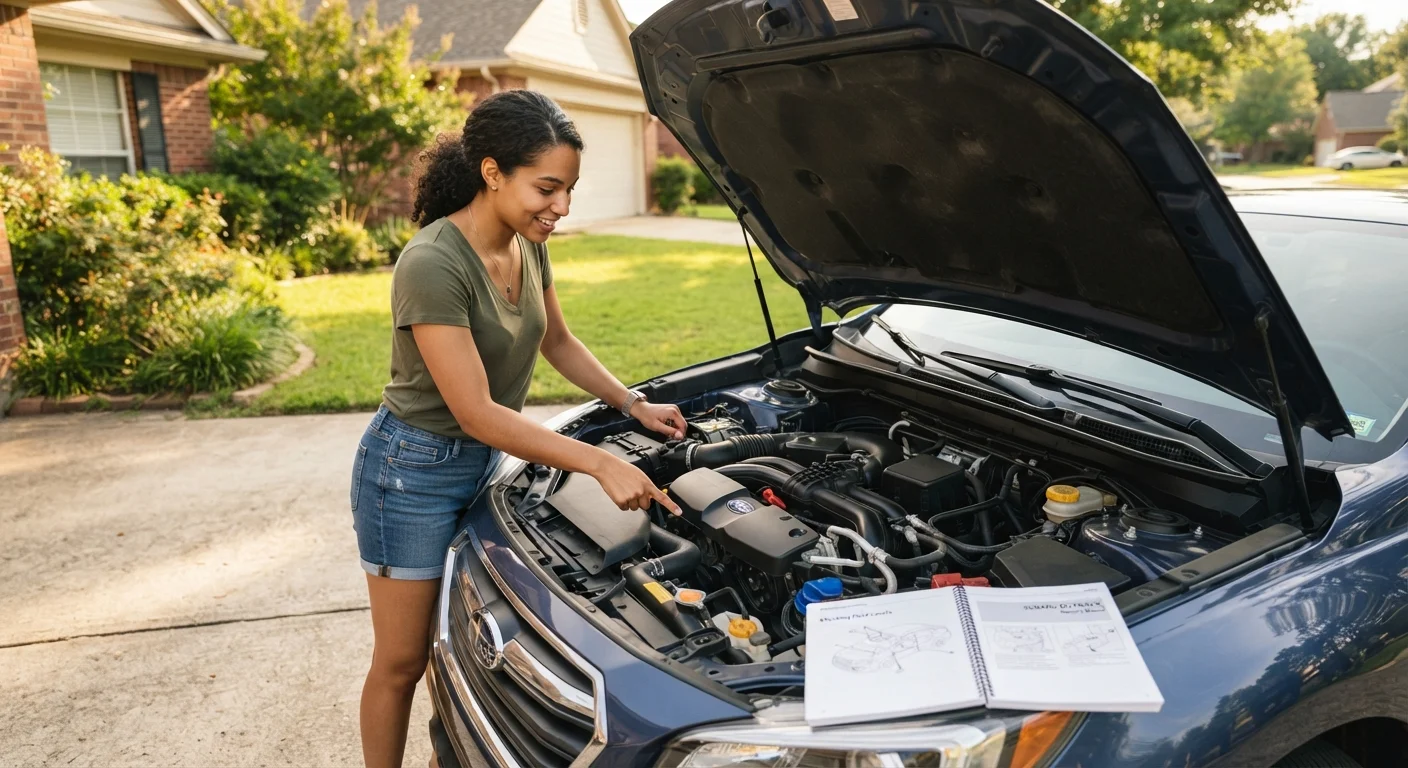
Every vehicle comes with an owner's manual — and most end up forgotten in the glove box. This is a missed opportunity. The manual is the single most accurate source of information about your specific car: its recommended service intervals, fluid types, tire pressure specifications, and warning light meanings are all documented there by the manufacturer.
Before consulting general advice online, check your manual first. A maintenance schedule written for your exact make, model, and engine is more reliable than a generic guideline. If you purchased a used vehicle without a manual, most manufacturers make digital versions available through their official websites.
Engine oil
A lubricating fluid that reduces friction between the engine's moving metal parts. It degrades over time and must be replaced at regular intervals to protect the engine.
Tire pressure (PSI)
The amount of air inside a tire, measured in pounds per square inch (PSI). Correct pressure ensures safe handling, even tread wear, and fuel efficiency.
Coolant
A liquid circulated through the engine to regulate temperature and prevent overheating. Also called antifreeze, it must be maintained at the correct level and concentration.
Service interval
The recommended time or mileage between specific maintenance tasks, as set by the vehicle manufacturer and documented in the owner's manual.
Dipstick
A long metal rod inserted into the engine oil reservoir that allows you to check the oil level without tools — markings on the rod show minimum and maximum safe levels.
Fault code
A diagnostic code stored by the vehicle's onboard computer when it detects an issue. A code reader or scan tool can retrieve this code to help identify what triggered a warning light.
Essential Maintenance Tasks Every New Driver Should Know
You don't need mechanical expertise to stay on top of basic vehicle health. Several important checks require nothing more than attention and a few minutes of your time.
- Engine oil: Oil lubricates the engine's moving parts. Check the level using the dipstick (with the engine off and cool) and monitor for any warning light indicating low oil pressure. Follow your manual's recommended oil change interval.
- Tire pressure and condition: Underinflated or worn tires affect braking, handling, and fuel efficiency. Check pressure monthly using a gauge and inspect tread depth regularly. The recommended PSI is on a sticker inside the driver's door frame.
- Coolant: Engine coolant prevents overheating. The reservoir has min/max markings — check it when the engine is cold and never open the cap on a hot engine.
- Windshield washer fluid: This is safe to top up yourself and is important for visibility in dirty or wintry conditions.
- Lights: Walk around the vehicle periodically to confirm all headlights, brake lights, turn signals, and reverse lights are working. A failed brake light can be a safety and legal issue.
Pair these checks with a pre-drive safety check before longer journeys to catch problems early.
Fluid levels vary by vehicle
Not all vehicles have the same fluid reservoirs or check procedures. Some modern cars have sealed transmissions with no user-accessible dipstick, and others use different oil check methods than traditional designs. Always refer to your owner's manual rather than assuming a procedure applies to your specific vehicle.
When to DIY and When to See a Mechanic
Knowing what you can safely handle and what requires professional attention is one of the most important distinctions for any new driver. Tasks like checking fluid levels, inflating tires, and replacing wiper blades are within reach for most people with basic instructions.
However, certain jobs carry real risks if performed incorrectly. Brake system work, suspension repairs, electrical diagnostics, and anything involving raising the vehicle on jack stands should be entrusted to a qualified mechanic. Attempting complex repairs without the proper tools, training, or workspace can result in vehicle damage or personal injury.
If a dashboard warning light appears and you're unsure what it means, don't ignore it and don't guess. Have the vehicle inspected. Many auto parts stores can read basic fault codes at no charge, though a full diagnosis requires a qualified technician.
Never ignore brake system warning lights
A brake warning light signals a condition that could directly affect your ability to stop the vehicle safely. Do not continue driving if this light appears without first understanding the cause. Have the vehicle inspected by a qualified mechanic as soon as possible, and avoid highway driving until it has been assessed.
Keeping Track: Service Records and Seasonal Checks
Building a habit of tracking your car's service history pays off in multiple ways. It helps you stay ahead of upcoming maintenance, gives a mechanic useful context when diagnosing a problem, and supports the vehicle's resale value. Our guide to keeping accurate service records explains exactly how to do this and why it matters more than most drivers expect.
Beyond the regular schedule, vehicles benefit from seasonal attention. Weather changes affect tires, batteries, fluids, and visibility equipment in ways that a fixed annual routine may miss. A seasonal maintenance checklist can help you adapt your approach as conditions shift.
Finally, consult the maintenance timelines most drivers misjudge to make sure your expectations around service intervals are accurate — many commonly held assumptions about when to service brakes, transmission fluid, and coolant turn out to be wrong.
Ownership is an ongoing responsibility. Drivers who treat maintenance as a routine part of that commitment tend to experience fewer surprises, lower long-term costs, and greater confidence on the road.
Frequently Asked Questions
The correct interval depends on your specific vehicle and the type of oil used. Consult your owner's manual for the manufacturer's recommended schedule — it typically ranges from every 3,000 to 10,000 miles depending on oil type and driving conditions. Following that guidance is more reliable than generic rules of thumb.
Skipping maintenance allows minor wear to progress unchecked, which can lead to more expensive repairs and reduced safety over time. For example, neglecting oil changes can accelerate engine wear, while ignoring brake checks can compromise stopping ability. Staying on schedule is far less costly than reactive repairs.
Yes — checking tire pressure is one of the simplest tasks any driver can do. You need only an inexpensive tire pressure gauge, available at most auto parts stores. Check when tires are cold (the car has been parked for at least three hours), and match the recommended PSI listed in your owner's manual or on the door jamb sticker.
Warning lights for the engine (check engine), oil pressure, battery, brake system, and temperature should be treated as urgent. If any of these illuminate while driving, it is safest to pull over when it is safe to do so and consult a qualified mechanic rather than continuing to drive until the issue is diagnosed.
Yes. Accurate service records demonstrate that your vehicle has been properly maintained, which supports reliability and can affect resale value. Keep receipts, work orders, and dates in a dedicated folder — whether paper or digital — so you always have a clear service history.
Most new drivers can safely check and top up windshield washer fluid, check tire pressure, inspect exterior lights, and monitor fluid levels by reading dipsticks and reservoir markings. Tasks involving the brake system, electrical work, or anything requiring the car to be raised should be handled by a qualified mechanic.
The content provided on our blog site traverses numerous categories, offering readers valuable and practical information. Readers can use the editorial team’s research and data to gain more insights into their topics of interest. However, they are requested not to treat the articles as conclusive. The website team cannot be held responsible for differences in data or inaccuracies found across other platforms. Please also note that the site might also miss out on various schemes and offers available that the readers may find more beneficial than the ones we cover.