

More Than Just Paperwork
Most drivers think of service records the way they think of instruction manuals — important enough to tuck into a glove box and never look at again. That's a costly habit. A thorough, up-to-date service history is one of the most practical tools a vehicle owner has, affecting everything from resale value to how quickly a mechanic can identify a developing problem.
Whether you drive a brand-new vehicle or a well-used one, understanding what to record, how to store it, and why it matters puts you in a stronger position as an owner. Consider it one layer of protection that costs almost nothing to maintain. For an overview of what ownership responsibility actually involves, see our guide for new drivers.
Up to 10%
Potential resale value boost from full service history
Industry observers and used-car valuation experts widely note that verifiable service records can add measurable value at point of sale, though exact figures vary by vehicle age and market.
1 in 3
Used car buyers who cite service history as a top purchase factor
Consumer surveys on used vehicle purchases consistently rank documented maintenance history among the most influential factors for private buyers and dealers alike.
What Belongs in a Complete Service Record
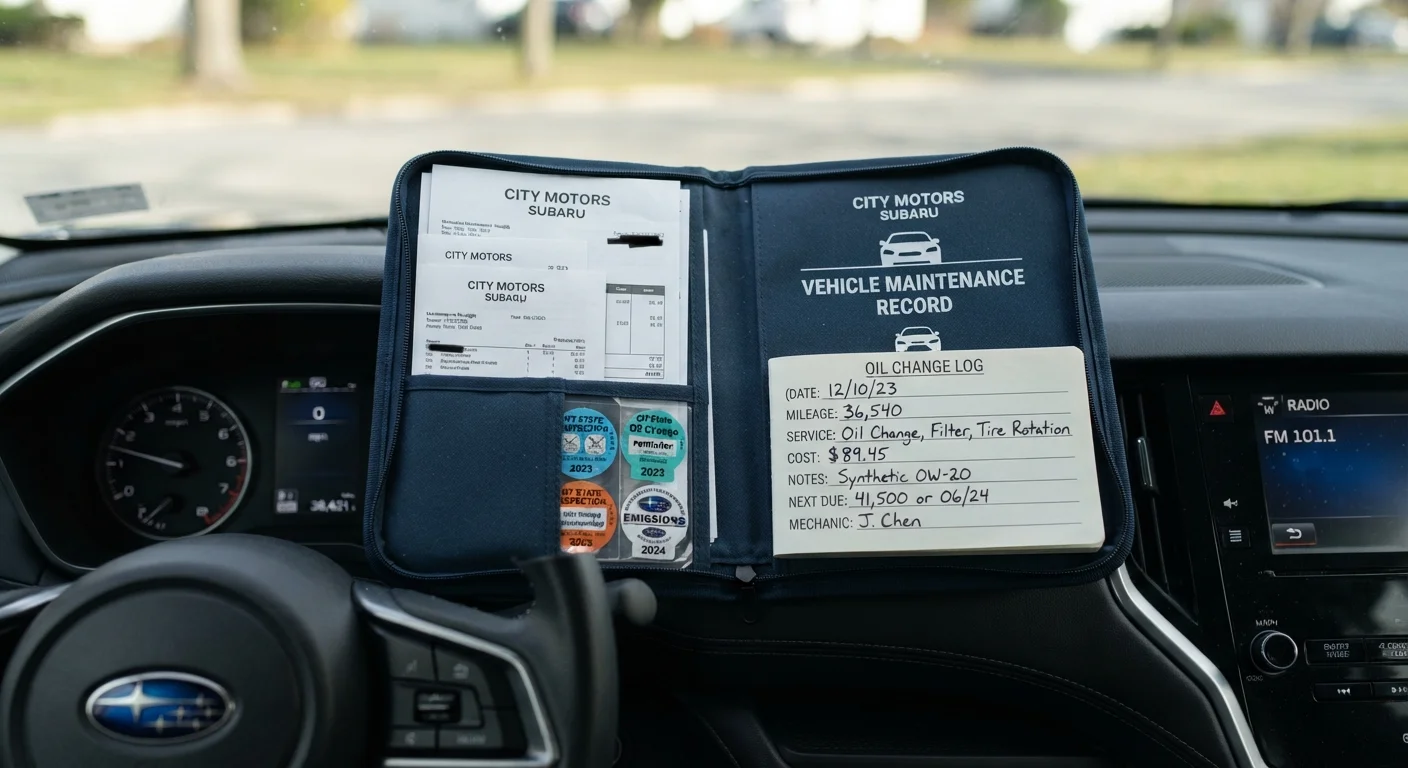
A useful service log goes beyond noting when you last changed the oil. For each service visit — whether at a dealership, independent shop, or performed yourself — the record should capture:
- Date and odometer reading at time of service
- Service performed in plain language (e.g., oil and filter change, tire rotation, brake pad replacement)
- Parts used, including part numbers where relevant
- Name and address of the shop or technician
- Cost paid and any warranty offered on parts or labor
- Next recommended service interval if noted
Receipts from shops typically capture most of this automatically — the habit is simply keeping them. For self-performed maintenance, a handwritten or digital log entry works just as well, provided it's consistent. Understanding standard service intervals helps you know what should appear in your log; our article on routine maintenance timelines covers what to expect and when.
Snap a Photo Right at the Shop
The easiest moment to preserve a service record is the moment you receive it. Before you leave the service bay or counter, photograph the receipt with your phone and store it in a dedicated album or cloud folder. This single habit eliminates the most common reason records go missing — they simply never make it home intact.
The Real-World Benefits Drivers Overlook
Service records pay dividends in situations most drivers don't anticipate until they're in them.
Keep every service receipt, even for minor jobs.
Receipts create a chronological paper trail that proves work was done, what parts were used, and when. This protects you if a warranty dispute arises and gives future owners — or buyers — confidence in the vehicle's history.
Record odometer readings at every service, not just dates.
Dates alone don't tell the full story — a vehicle driven 25,000 miles in one year needs service at different intervals than one covering 8,000 miles. Mileage-based records ensure you're actually following manufacturer-recommended intervals.
Store records in at least two formats — physical and digital.
Paper receipts fade, get wet, or are accidentally discarded. Digital copies stored in a cloud folder or an automotive app survive these scenarios. Having both formats means you're covered regardless of what happens to either copy.
Note deferred repairs alongside completed ones.
When a technician flags something that wasn't fixed that visit — worn wiper blades, a marginal battery, a slow tire leak — writing it down prevents it from falling through the cracks. It also shows future mechanics the full picture of the vehicle's condition history.
Verify that warranty-required services are documented correctly.
Many manufacturer and extended warranties specify that services be performed at defined intervals and recorded. An undocumented service — even one that genuinely happened — may not satisfy a warranty claim if you can't prove it occurred.
Depreciation is a factor every owner should understand alongside maintenance. A well-documented service history is one of the few things within your control that can slow value loss — learn more in our piece on why cars lose value faster than expected.
How to Start — or Restart — Your Records
If your records have gaps, don't be discouraged. Starting today still adds value, and some history is always better than none.
For a broader look at keeping your vehicle in shape across the year, the seasonal car maintenance checklist is a useful complement to any service log routine.
What Happens When You Sell or Buy
When selling a vehicle privately, a complete service record gives buyers confidence and supports the asking price. When buying used, always request the service history and cross-reference key entries against a vehicle history report. Our article on understanding a vehicle history report explains what those reports can and cannot verify — service records in your hand fill in what third-party reports often miss.
The content provided on our blog site traverses numerous categories, offering readers valuable and practical information. Readers can use the editorial team’s research and data to gain more insights into their topics of interest. However, they are requested not to treat the articles as conclusive. The website team cannot be held responsible for differences in data or inaccuracies found across other platforms. Please also note that the site might also miss out on various schemes and offers available that the readers may find more beneficial than the ones we cover.