

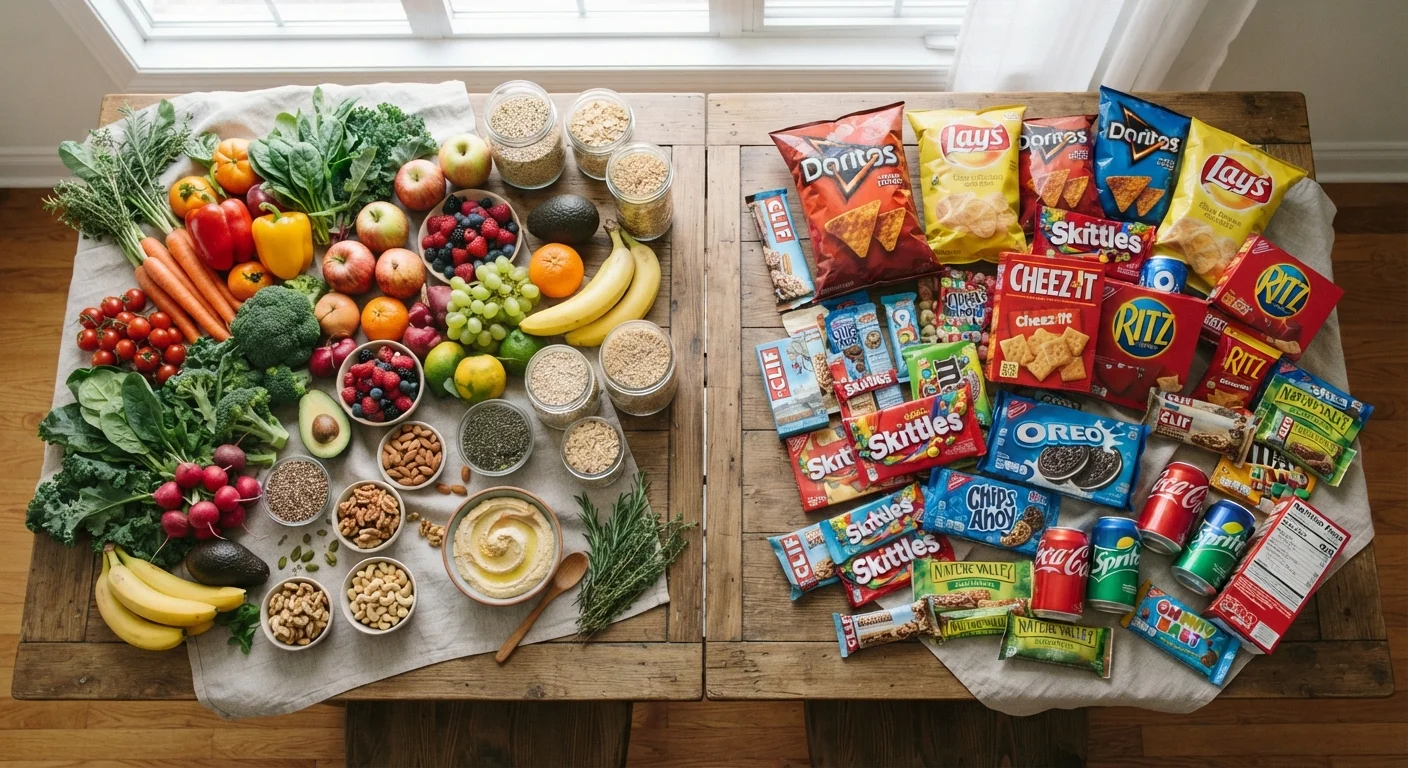
Option A
Whole Foods
The minimally altered, nutrient-dense foundation of most healthy diets.
Best for: People looking to maximize fiber, micronutrients, and satiety with foods close to their natural state.
Option B
Processed Foods
A broad and often misunderstood category ranging from mildly altered to heavily engineered.
Best for: Understanding when convenience foods fit reasonably into a balanced diet — and when they don't.
What 'Processed' Actually Means
The word processed carries a lot of baggage in nutrition conversations, often used as a blanket label for anything deemed unhealthy. In reality, processing describes any deliberate change made to a food before it reaches your plate — and that definition is far wider than most people expect.
Washing, cutting, freezing, fermenting, cooking, canning, and drying are all forms of processing. By that standard, bagged spinach, plain Greek yogurt, and canned chickpeas are all technically processed. The more useful question isn't whether a food was processed, but how much and to what end.
Nutrition researchers commonly use the NOVA classification system, which groups foods into four categories: unprocessed or minimally processed foods; processed culinary ingredients (like oils and flours); processed foods (canned, salted, or smoked); and ultra-processed foods — industrially formulated products that contain ingredients rarely found in a home kitchen, such as emulsifiers, flavor enhancers, and artificial colorings. Understanding these distinctions helps cut through the noise of food marketing. As our team notes in our breakdown of misleading nutrition claims, blanket labels can be more confusing than clarifying.
The NOVA System Is a Research Tool, Not a Food Law
The NOVA classification is widely used in nutrition research but is not an official regulatory standard in the United States. It provides a useful framework for thinking about food processing levels, but the boundaries between categories can be subjective in practice. Use it as a thinking tool rather than a rigid rulebook when evaluating your food choices.
Whole Foods: What They Offer
Whole foods are foods that are eaten in or very close to their natural state — think fresh fruit, vegetables, legumes, whole grains, nuts, seeds, eggs, and unprocessed meat or fish. Their defining nutritional advantage is completeness: these foods contain the full matrix of nutrients, fiber, and bioactive compounds (phytochemicals, antioxidants) that nature packaged together.
Dietary fiber, found abundantly in whole plant foods, supports digestive health, helps regulate blood sugar levels, and contributes to a feeling of fullness — a property called satiety. Most Americans consume well under the recommended daily fiber intake, and whole foods are the primary source of this essential nutrient. Beyond fiber, the micronutrient density of whole foods — vitamins, minerals, and plant compounds — is difficult to replicate in highly processed alternatives, even when those products are fortified.
For those interested in the broader role of food components, our guide to macronutrients explains how carbohydrates, proteins, and fats function together in the body — context that helps make sense of why food quality matters beyond just calorie counts.
~58%
Share of US calories from ultra-processed foods
Research published in BMJ Open estimated that ultra-processed foods account for roughly 58% of total daily energy intake in the US diet.
7%
Average daily fiber intake vs. recommended
The American Heart Association notes most Americans consume well under the recommended 25–38 grams of fiber per day, with whole plant foods being the primary source.
2x+
Higher obesity association with ultra-processed diets
Multiple large cohort studies have found individuals with the highest ultra-processed food intake have substantially higher odds of obesity compared to those with the lowest intake.
A Side-by-Side Look at the Spectrum
Comparing whole foods to processed foods only becomes meaningful when you're specific about where on the processing spectrum a food sits. The table below illustrates key differences across several nutritional and practical dimensions.
| Criterion | Whole Foods | Processed Foods |
|---|---|---|
| Fiber content | Naturally high in fiber | Often reduced or absent in ultra-processed products |
| Added sugars | None added | Frequently added, especially in ultra-processed items |
| Sodium levels | Naturally low | Can be high; varies widely by product |
| Micronutrient density | Naturally rich in vitamins and minerals | Sometimes fortified; often lower overall |
| Ingredient list | One ingredient (the food itself) | Ranges from a few to dozens of ingredients |
| Shelf life | Generally short; requires refrigeration | Often longer due to preservatives or packaging |
| Convenience | Requires more preparation time | Ready-to-eat or quick to prepare |
| Cost variability | Can be high for fresh produce; lower for dried/frozen | Ranges from budget-friendly to premium |
Notice that the comparison shifts significantly depending on the level of processing. Frozen peas (minimally processed) are nutritionally close to fresh peas. A cheese cracker engineered with refined flour, palm oil, and natural flavors is a different matter entirely. When evaluating your choices, checking the ingredient list is one of the most reliable tools available — a short list of recognizable ingredients generally signals less extensive processing. Reading nutrition labels effectively is a practical skill that pairs directly with this understanding.
What the Research Says About Ultra-Processed Foods
A growing body of epidemiological research — including large prospective cohort studies — has found associations between high consumption of ultra-processed foods and increased risks of cardiovascular disease, type 2 diabetes, obesity, and certain cancers. These are observational studies, which means they identify associations rather than establish direct cause and effect, but the consistency of findings across different populations is notable.
Researchers propose several mechanisms: ultra-processed foods tend to be energy-dense but low in fiber and micronutrients; their texture and formulation may reduce the body's natural satiety signals; and some additives are under active investigation for effects on gut microbiome health. It's worth emphasizing, however, that diet quality is cumulative. A single ultra-processed food in an otherwise nutrient-rich diet carries far less significance than a pattern of heavy reliance on such products.
A plant-forward eating pattern is one approach that naturally emphasizes whole and minimally processed foods, though it's not the only path to a balanced diet.
Making Practical Choices Without All-or-Nothing Thinking
Nutrition science does not support the idea that a single food — or category of food — determines health outcomes. What matters most is overall dietary pattern over time. That means there is meaningful room for pragmatism.
Practically speaking, building a diet with more whole and minimally processed foods at its core — plenty of vegetables, fruits, legumes, whole grains, and lean proteins — provides a strong nutritional foundation. From there, incorporating minimally processed convenience items like canned tomatoes, plain frozen edamame, or low-sodium canned fish fills gaps without meaningful nutritional compromise.
The foods to be more mindful of are those at the ultra-processed end of the spectrum: packaged snacks, sugar-sweetened beverages, instant noodles, and heavily flavored ready meals consumed frequently. Not because occasional consumption causes harm, but because regular reliance on them tends to crowd out the whole-food variety that supports long-term health.
If you have specific health conditions or dietary goals, a registered dietitian can help translate general principles into guidance tailored to your circumstances. This article is intended as general health education and is not a substitute for professional medical or nutritional advice.
This article is for informational and educational purposes only and does not constitute medical or nutritional advice. Consult a qualified healthcare professional before making significant changes to your diet, particularly if you have an existing health condition.
The content provided on our blog site traverses numerous categories, offering readers valuable and practical information. Readers can use the editorial team’s research and data to gain more insights into their topics of interest. However, they are requested not to treat the articles as conclusive. The website team cannot be held responsible for differences in data or inaccuracies found across other platforms. Please also note that the site might also miss out on various schemes and offers available that the readers may find more beneficial than the ones we cover.