

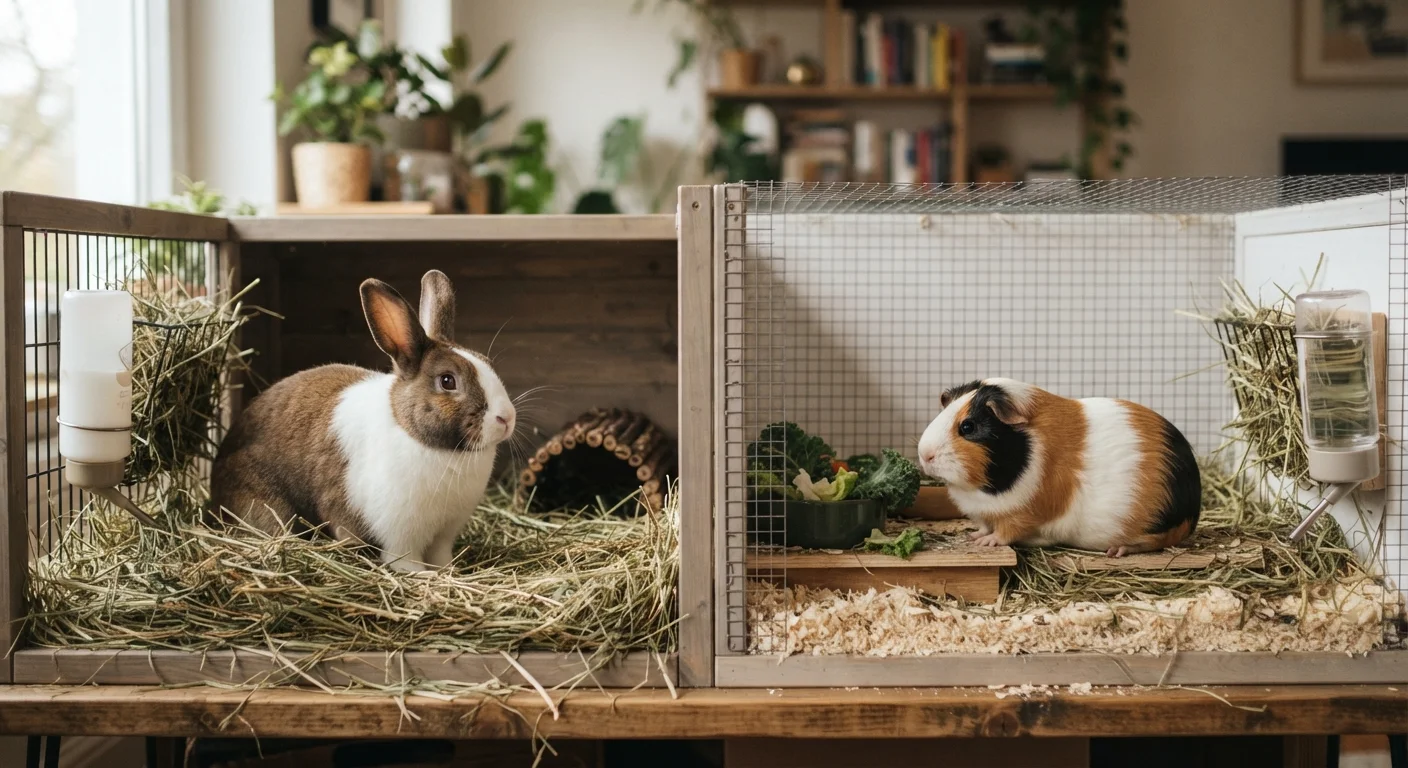
A Common but Risky Assumption
Walk into any pet store and you'll often see rabbits and guinea pigs housed side by side — sometimes even together. It's an understandable assumption: both are small, herbivorous, and gentle-looking. New owners frequently conclude that pairing them saves space and provides companionship for both animals.
In reality, housing guinea pigs and rabbits together creates measurable health and welfare risks for guinea pigs in particular. Animal welfare organizations — including the RSPCA and the Humane Society — have moved firmly away from recommending this pairing. The reasoning isn't arbitrary; it's grounded in biology, behavior, and disease transmission.
If you're caring for small pets and want to make sure their environment truly supports them, it's worth understanding exactly why this combination causes problems — and what each species actually needs instead. For rabbit owners specifically, see our guide to rabbit housing for species-appropriate setup advice.
Myth
Guinea pigs and rabbits are so similar that they make natural companions for each other.
Fact
They are different species with incompatible communication styles, dietary needs, and social behaviors.
While both animals are small herbivores, they belong to entirely different biological orders. Rabbits are lagomorphs; guinea pigs are rodents. Their body language, vocalizations, and social structures evolved separately. A rabbit's normal behaviors — such as thumping, lunging, or mounting — can be deeply distressing to a guinea pig that has no way to interpret or respond to those signals appropriately.
Myth
Rabbits are gentle enough that they won't hurt a guinea pig.
Fact
Rabbits can injure guinea pigs through kicks, mounting, and chasing — often without any aggressive intent.
Rabbits have powerful hind legs built for speed and defense. A single kick — even a reflexive one from a startled rabbit — can fracture a guinea pig's spine. Rabbits also commonly attempt to mount guinea pigs as a dominance behavior, which causes significant stress and potential physical harm. These incidents don't require the rabbit to be aggressive; normal rabbit behavior is simply incompatible with guinea pig safety.
Myth
Sharing a hutch is fine as long as both animals seem calm.
Fact
Stress in prey animals is often silent; apparent calm does not indicate the animals are thriving.
Guinea pigs and rabbits are both prey species that instinctively suppress outward signs of distress. A guinea pig may appear calm while experiencing chronic low-level stress from an incompatible housing situation. Indicators of chronic stress — reduced appetite, hiding, changes in droppings, or weight loss — can be subtle and easy to miss without regular, attentive observation. Behavioral calm should never be read as evidence that cohabitation is working.
Myth
Bordetella (kennel cough) only affects dogs, so it's not a concern with rabbits.
Fact
Rabbits can carry Bordetella bronchiseptica and transmit it to guinea pigs, causing serious respiratory disease.
Bordetella bronchiseptica is a bacterial pathogen that rabbits can harbor without showing any symptoms themselves. For guinea pigs, exposure to this bacterium can cause severe pneumonia that is often fatal. There is currently no licensed vaccine for guinea pigs against this pathogen in many regions, making prevention — primarily through species separation — the most reliable protective measure. This is one of the most serious documented risks of rabbit-guinea pig cohousing.
Health and Nutritional Incompatibilities
Beyond the myths, two practical issues affect day-to-day care for any owner who keeps both species, even in separate enclosures nearby.
~10 mg
Daily vitamin C needed per 100g of guinea pig body weight
According to veterinary nutrition guidelines, guinea pigs require consistent dietary vitamin C to prevent scurvy, unlike rabbits who produce their own.
100%
Of major animal welfare bodies advising against rabbit-guinea pig cohousing
Organizations including the RSPCA and the Humane Society have updated their guidance to explicitly recommend against housing these species together.
Vitamin C is non-negotiable for guinea pigs. Unlike rabbits, guinea pigs cannot synthesize their own vitamin C and must get it through fresh food daily. If they share a feeding area or receive the same diet, guinea pigs risk developing scurvy — a painful and preventable condition. Pellets formulated for rabbits contain no added vitamin C, and guinea pig pellets may contain additives that aren't appropriate for rabbits. For a broader look at common small pet feeding mistakes, see what small pet owners often get wrong about diet.
Never Share Food Bowls Between Species
Rabbit pellets do not contain added vitamin C, which guinea pigs require daily. Guinea pig pellets may contain ingredients in amounts unsuitable for rabbits. Even brief shared access to the wrong food can contribute to nutritional deficiencies over time. Always feed each species separately with food formulated for that animal.
Keeping each species in its own species-appropriate space, with its own food and social companions, is the most straightforward way to meet both animals' welfare needs.
What Each Species Needs Instead
Guinea pigs thrive with other guinea pigs. They are highly social animals that rely on same-species communication — vocalizations like purring, chutting, and wheeking carry specific social meaning that rabbits simply don't share or respond to. A guinea pig housed alone without a compatible companion, or with an incompatible species, is at elevated risk for chronic stress.
Rabbits, meanwhile, have their own complex social and spatial requirements. They need room to run, jump, and express natural behaviors — far more space than is often provided. A rabbit kept in a small hutch, with or without a guinea pig, is unlikely to meet its behavioral needs. Understanding those needs in detail matters as much as knowing what not to do.
Same-Species Companionship Is Healthiest
The best companion for a guinea pig is another guinea pig; the best companion for a rabbit is another compatible rabbit. Providing a same-species pair or group meets each animal's social needs without introducing the health and safety risks that cross-species housing creates. If you're unsure how to introduce same-species companions, consult a small-animal veterinarian or a knowledgeable rescue organization.
If you're new to small pet ownership more broadly, the principles of species-appropriate housing apply across the board — from guinea pigs and rabbits to hamsters. Our hamster enclosure guide illustrates how different even closely related small animals can be in their housing requirements.
This article is for general informational purposes only. For concerns about your pet's health or behavior, consult a veterinarian experienced with small animals.
The content provided on our blog site traverses numerous categories, offering readers valuable and practical information. Readers can use the editorial team’s research and data to gain more insights into their topics of interest. However, they are requested not to treat the articles as conclusive. The website team cannot be held responsible for differences in data or inaccuracies found across other platforms. Please also note that the site might also miss out on various schemes and offers available that the readers may find more beneficial than the ones we cover.