

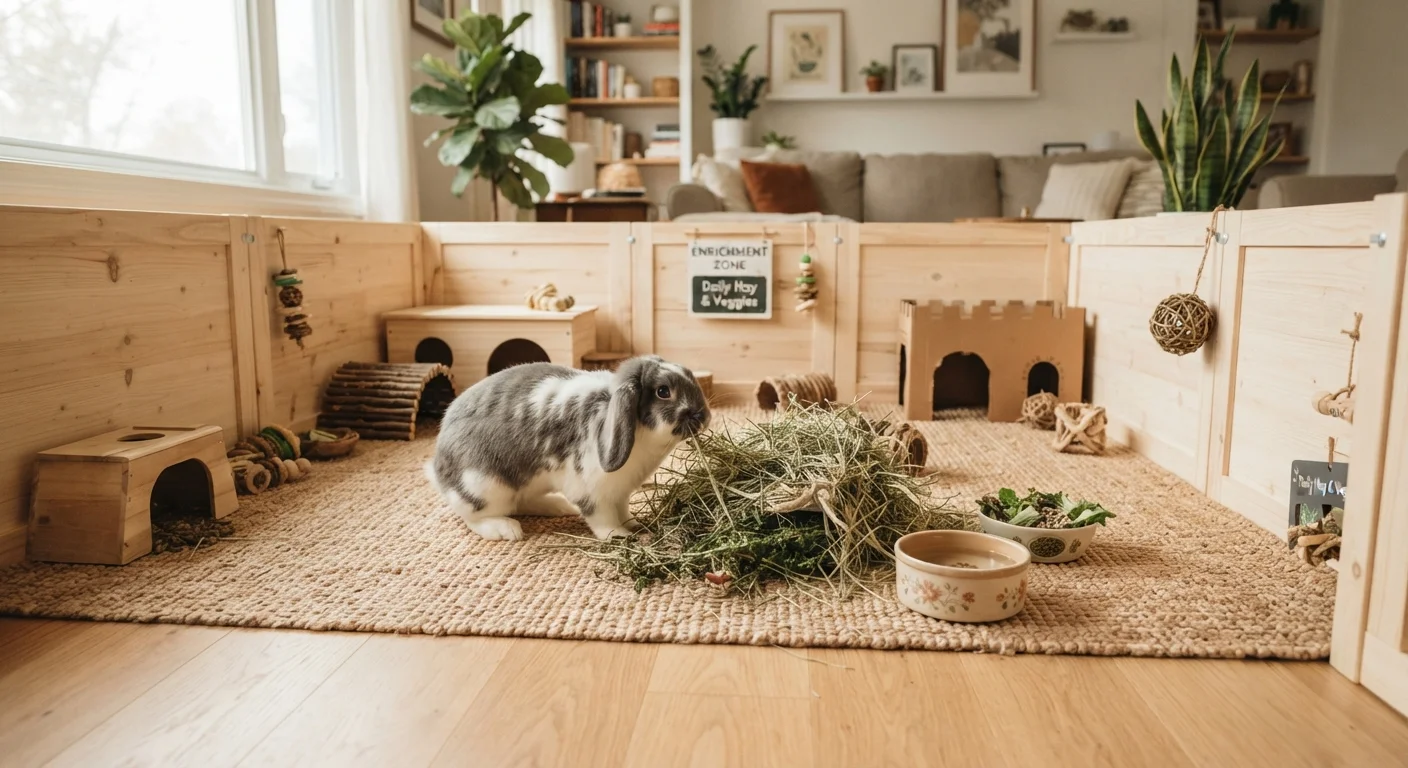
Why Most Traditional Rabbit Cages Fall Short
Walk into any pet store and you'll find compact wire cages marketed for rabbits. The problem? Most of them are far too small for a rabbit to live comfortably — or even safely. A rabbit needs enough room to take at least three full consecutive hops, stand fully upright on its hind legs, and stretch out completely when lying down. Few commercial cages meet that standard.
Rabbit welfare organizations, including the House Rabbit Society, recommend a minimum living area of 12 square feet for a single rabbit, with access to a separate exercise area of 32 square feet or more each day. For context, that exercise space is roughly the size of a medium bathroom — and it should be available consistently, not just occasionally.
If you're still weighing what kind of small pet fits your home and routine, our guide on matching your lifestyle to the right small animal can help you assess whether a rabbit is the right fit before you invest in a setup.
12 sq ft
Minimum recommended living space for one rabbit
House Rabbit Society guidelines suggest 12 square feet of enclosure space, separate from daily exercise area.
32 sq ft
Recommended daily exercise space
Rabbit welfare organizations advise providing at least 32 square feet of safe roaming area every day.
~80%
Portion of diet that should be hay
Veterinary nutritionists consistently recommend hay as the primary component of a domestic rabbit's diet for healthy digestion.
Indoor vs. Outdoor Housing: What to Consider
Rabbits can live indoors or outdoors, but each option comes with distinct considerations. Indoor housing is generally favored by rabbit welfare advocates because it keeps rabbits safe from predators, temperature extremes, and the psychological stress of feeling isolated from their family. Indoor rabbits also tend to have more opportunities for social interaction, which matters greatly for their mental health.
Outdoor hutches must be robustly constructed — weatherproof, insulated against both heat and cold, and designed so that no predator (even a determined neighborhood cat or raccoon) can reach the rabbit through the enclosure walls. Even the sight or smell of a predator outside a hutch can cause a rabbit extreme and prolonged stress.
Temperature Ranges Matter More Than You Think
Rabbits are sensitive to heat and can experience heatstroke at temperatures above 85°F. They also struggle in damp, drafty conditions. Whether housing is indoors or outdoors, aim to keep the rabbit's environment between 60°F and 72°F. In summer, ensure shade, ventilation, and access to cool ceramic tiles or frozen water bottles to lean against.
Whatever housing type you choose, the enclosure should never be placed in a garage where vehicles run, as carbon monoxide and fumes are dangerous to rabbits even in small concentrations.
Flooring, Bedding, and Enclosure Setup
Wire-bottom flooring is one of the most common and preventable hazards in rabbit housing. Rabbit feet are not padded like cats' or dogs' — they have fine fur and delicate skin over bone. Constant contact with wire causes sore hocks, a painful pressure-wound condition that can become serious if untreated. Always opt for solid flooring.
Safe bedding choices include paper-based bedding, natural-fiber mats, and washable fleece liners. Avoid cedar and pine shavings, which contain aromatic oils that can irritate a rabbit's respiratory tract.
Inside the enclosure, every rabbit needs:
- A constant, unlimited supply of fresh timothy or grass hay (hay makes up the bulk of a healthy rabbit's diet)
- Fresh water in a heavy ceramic bowl or sipper bottle
- A litter box in a corner the rabbit naturally gravitates toward
- At least one hiding spot or enclosed shelter for security
- Enrichment items such as tunnels, chew toys, or cardboard
For more on how diet fits into the full picture of small pet care, see what small pet owners often get wrong about diet.
Litter Training Makes Cleaning Much Easier
Rabbits naturally choose one or two corners for elimination, which makes litter training relatively straightforward. Place a litter box in the corner your rabbit already uses, filled with paper-based litter and a generous layer of hay on top. Rabbits often eat hay while using the litter box — this is normal and actually encourages good litter habits.
Enrichment, Companionship, and Space to Roam
A correctly sized enclosure is a foundation — not a complete solution. Rabbits are highly social, cognitively active animals that need daily mental and physical engagement. In the wild, they would spend hours foraging, exploring, and interacting with other rabbits. A static environment without variety or companionship often leads to boredom, depression, or destructive behavior.
Companionship: Many rabbit welfare experts recommend keeping rabbits in bonded pairs rather than alone. A neutered male-female pairing is typically the most compatible. Introducing rabbits requires a gradual, supervised process — never place two unfamiliar rabbits directly into the same space.
Daily exercise: Rabbits should have supervised free-roaming time outside their enclosure every day — ideally several hours. Rabbit-proof the room by covering electrical cords, blocking access to toxic houseplants, and removing items that could be chewed unsafely.
The enrichment principles that apply to rabbits share meaningful overlap with those for other companion animals. If you're also a cat owner, our piece on setting up your home to keep a cat mentally stimulated explores similar enrichment strategies for a different species.
“Rabbits are not low-maintenance pets. They have complex social and environmental needs that, when met, allow them to live long and fulfilling lives alongside their human families.”
— House Rabbit Society, Nonprofit rabbit welfare and education organization
This article is for general informational purposes only and is not a substitute for veterinary advice. Always consult a rabbit-experienced veterinarian for guidance specific to your animal's health and housing needs.
Frequently Asked Questions
Rabbit welfare organizations generally recommend a minimum living area of 12 square feet, combined with at least 32 square feet of daily exercise space. Bigger is always better. A single small cage, even with daily free-roaming time, often falls short of this standard.
Rabbits can live outdoors, but outdoor hutches come with serious risks including extreme temperatures, predator stress, and social isolation. If kept outside, the hutch must be insulated, predator-proof, and positioned where the rabbit can still interact with the household. Many rabbit advocates recommend indoor housing as the safer option.
A large exercise pen (playpen) is generally preferable to a traditional cage because it offers more space and easier expansion. Some owners combine a smaller sleeping enclosure attached to a large exercise pen. The key is that the total usable space meets minimum size guidelines.
No — housing rabbits and guinea pigs together is discouraged by veterinary and welfare experts. The two species have different dietary needs, communication styles, and disease risks. See our article on <a href="/pets-animals/small-pets/why-guinea-pigs-and-rabbits-shouldnt-share-a-hutch">why rabbits and guinea pigs shouldn't share a hutch</a> for a full explanation.
Solid flooring covered with a soft, absorbent material — such as fleece, natural-fiber mats, or paper-based bedding — is safest. Wire or slatted floors can cause a painful condition called sore hocks (ulcerative pododermatitis), where pressure wounds develop on the rabbit's feet.
Yes. Rabbits are curious and intelligent animals that need mental stimulation to avoid boredom and stress. Provide tunnels, hay-stuffed foraging toys, cardboard boxes to chew, and elevated platforms. Rotating enrichment items keeps the environment engaging.
The content provided on our blog site traverses numerous categories, offering readers valuable and practical information. Readers can use the editorial team’s research and data to gain more insights into their topics of interest. However, they are requested not to treat the articles as conclusive. The website team cannot be held responsible for differences in data or inaccuracies found across other platforms. Please also note that the site might also miss out on various schemes and offers available that the readers may find more beneficial than the ones we cover.