

Why Mental Stimulation Matters for Indoor Cats
Domestic cats — even the most relaxed ones — are hardwired predators. Their brains are built for stalking, pouncing, problem-solving, and exploring territory. When that drive has nowhere to go, boredom can set in quickly, and boredom in cats rarely looks like quiet contentment. It often shows up as destructive scratching, excessive meowing, over-grooming, or aggression toward other pets and people.
Research in feline behavioral science consistently links environmental enrichment to lower stress hormone levels and fewer unwanted behaviors. As our guide to common myths about cat independence explains, cats are far more emotionally complex than their reputation for aloofness suggests. Meeting their cognitive needs is as important as feeding them well.
The good news: you don't need a large home or a big budget. Strategic changes to how your space is organized can make a significant difference.
What you will need
Setting Up the Right Environment: Step by Step
Use the steps below to build a stimulating home environment tailored to your cat's size, age, and personality. Work through them in order, or focus on the areas where your cat currently seems most restless.
Cat tree or multi-level climbing tower
Provides vertical territory, resting platforms, and a scratching surface in one unit.
Wall-mounted shelves or cat shelves
Maximizes vertical space in smaller homes where floor space for a cat tree is limited.
Puzzle feeder or food-dispensing toy
Slows eating and channels hunting instincts into a problem-solving activity around mealtime.
Window perch or suction-cup shelf
Gives cats a dedicated spot to watch outdoor activity, acting as natural 'cat television.'
Cardboard scratching pad or sisal post
Satisfies the instinct to scratch and stretch, protecting furniture in the process.
Wand toys and feather teasers
Used during interactive play sessions to simulate prey movement and trigger predatory sequences.
Paper bags or cardboard boxes
Low-cost hiding and exploration spots that cats find genuinely engaging.
Create vertical territory with climbing structures
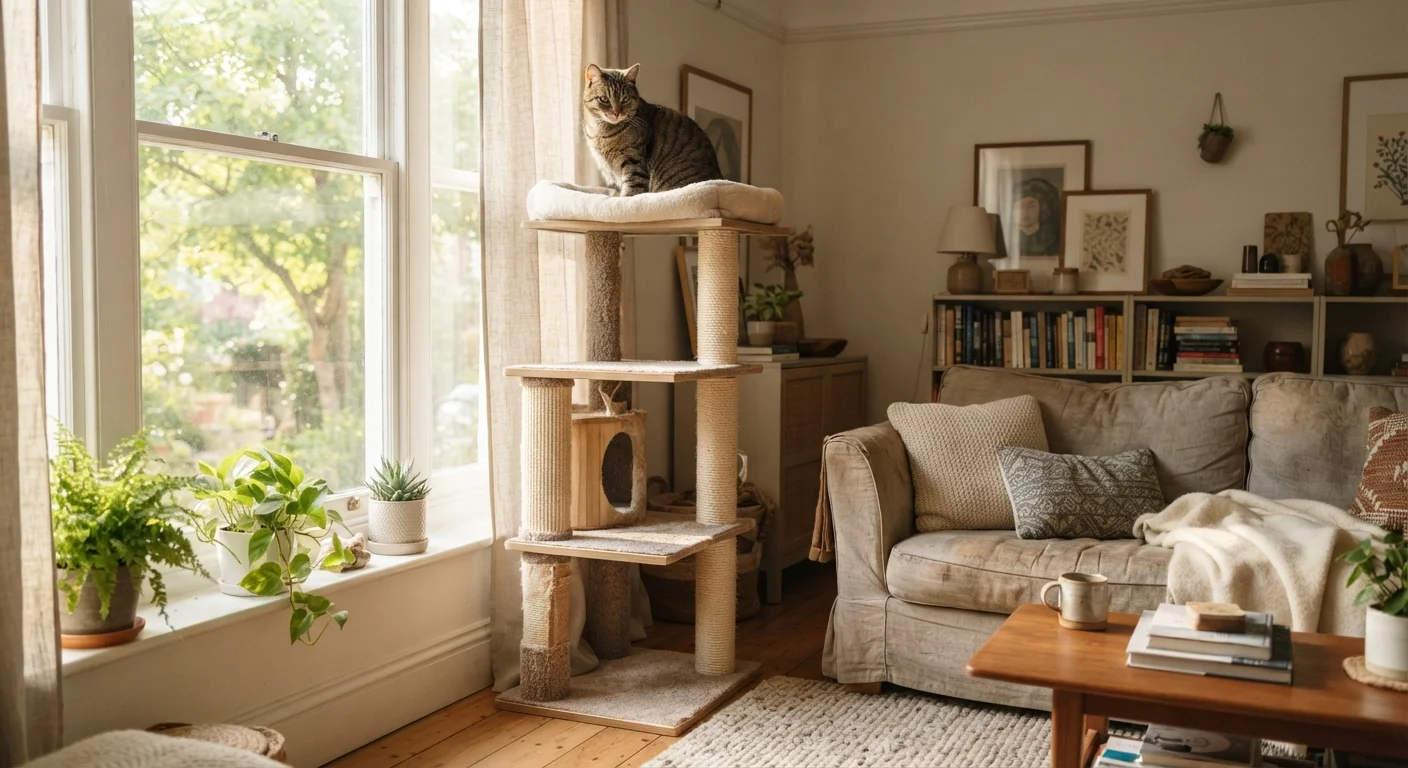
Cats feel safest when they can observe their environment from height. Install a sturdy cat tree near a window or in the room where your household spends the most time. Aim for at least two platforms at different heights. If floor space is tight, wall-mounted cat shelves arranged in a staggered path achieve the same result and can turn a blank wall into an enrichment highway.
Install a dedicated window viewing station
A window perch transforms any sill into a prime spot for watching birds, insects, and passing activity outdoors. Position it in front of a window that gets daytime foot traffic or natural bird activity. If you have a yard, a bird feeder placed within view of the window provides a reliable source of movement for your cat to track.
Introduce puzzle feeders at mealtimes
Swap one regular bowl meal per day for a puzzle feeder or food-dispensing toy. These devices require the cat to manipulate, paw, or roll an object to release kibble or small food portions. This mimics the effort a cat would naturally expend hunting prey, providing mental work tied to a highly motivating reward. Start with an easy puzzle and gradually increase complexity as your cat gets comfortable.
For cats on wet or raw diets, lick mats spread with soft food offer a similar low-effort entry point into feeding enrichment. Learn more about diet options in our feline nutrition guide.
Schedule daily interactive play sessions
Wand toys, feather teasers, and laser pointers (always end laser play with a tangible toy the cat can 'catch') should be used in structured sessions of 10–15 minutes, ideally once or twice a day. Move the toy in patterns that mimic real prey: dart it under a blanket, slow it down as if injured, then let the cat make the 'kill.' This full predatory sequence — stalk, chase, pounce, catch — is mentally satisfying in a way that passive toys cannot replicate.
Rotate toys and introduce novel scents
Keep a small reserve of toys out of rotation and swap them in every one to two weeks. A toy that has been hidden away for a fortnight registers as novel again to most cats. You can also introduce safe, cat-appropriate scents — dried catnip (which triggers a mild, temporary euphoric response in cats who are genetically receptive to it), silvervine, or valerian — applied to toys or a small cloth to add olfactory enrichment without cost.
Provide dedicated hiding and resting spots
Cats need private, secure spaces where they can retreat without being disturbed. A simple cardboard box with a cut-out entrance, a covered cat bed, or a blanket draped over the bottom shelf of a bookcase all work well. Distribute resting options at different heights so your cat can choose based on their mood. Multiple cats in one household each need their own retreat to prevent resource-guarding stress.
Troubleshooting and Long-Term Maintenance
Enrichment is not a one-time project — it requires periodic refreshing. Cats habituate quickly to static environments, so rotating items matters. Swap out one or two toys every week or two so that returning a stored toy feels like a new discovery. The same principle applies to hiding spots and resting surfaces.
Keep Enrichment Varied and Unpredictable
Cats are most engaged by novelty. Rather than leaving all enrichment items out permanently, rotate two or three items out of reach each week and reintroduce them later. This simple habit costs nothing and maintains a level of unpredictability that keeps a cat's environment genuinely interesting.
Watch your cat's behavior closely. If scratching at one specific spot, excessive napping, or sudden changes in appetite emerge even after enrichment changes, these can signal stress or an underlying health issue. A routine veterinary check-up can rule out medical causes for behavioral shifts.
If you are setting up for a new arrival, our first-time cat owner guide walks through the full settling-in process alongside these enrichment principles. And for cats who spend all their time indoors, reading our indoor vs. outdoor cat overview can help you weigh whether supervised outdoor access might further support their wellbeing.
Behavioral Changes May Signal a Health Issue
Sudden increases in hiding, aggression, or vocalization — even after you have improved enrichment — are not always behavioral in origin. Hyperthyroidism, pain, vision loss, and other medical conditions can produce similar signs. Do not assume enrichment changes alone will resolve new or escalating behavioral symptoms; consult a veterinarian to rule out underlying causes.
This article is for general informational purposes only and is not a substitute for professional veterinary advice. If your cat displays sudden or severe behavioral changes, consult a licensed veterinarian or certified animal behaviorist.
The content provided on our blog site traverses numerous categories, offering readers valuable and practical information. Readers can use the editorial team’s research and data to gain more insights into their topics of interest. However, they are requested not to treat the articles as conclusive. The website team cannot be held responsible for differences in data or inaccuracies found across other platforms. Please also note that the site might also miss out on various schemes and offers available that the readers may find more beneficial than the ones we cover.