

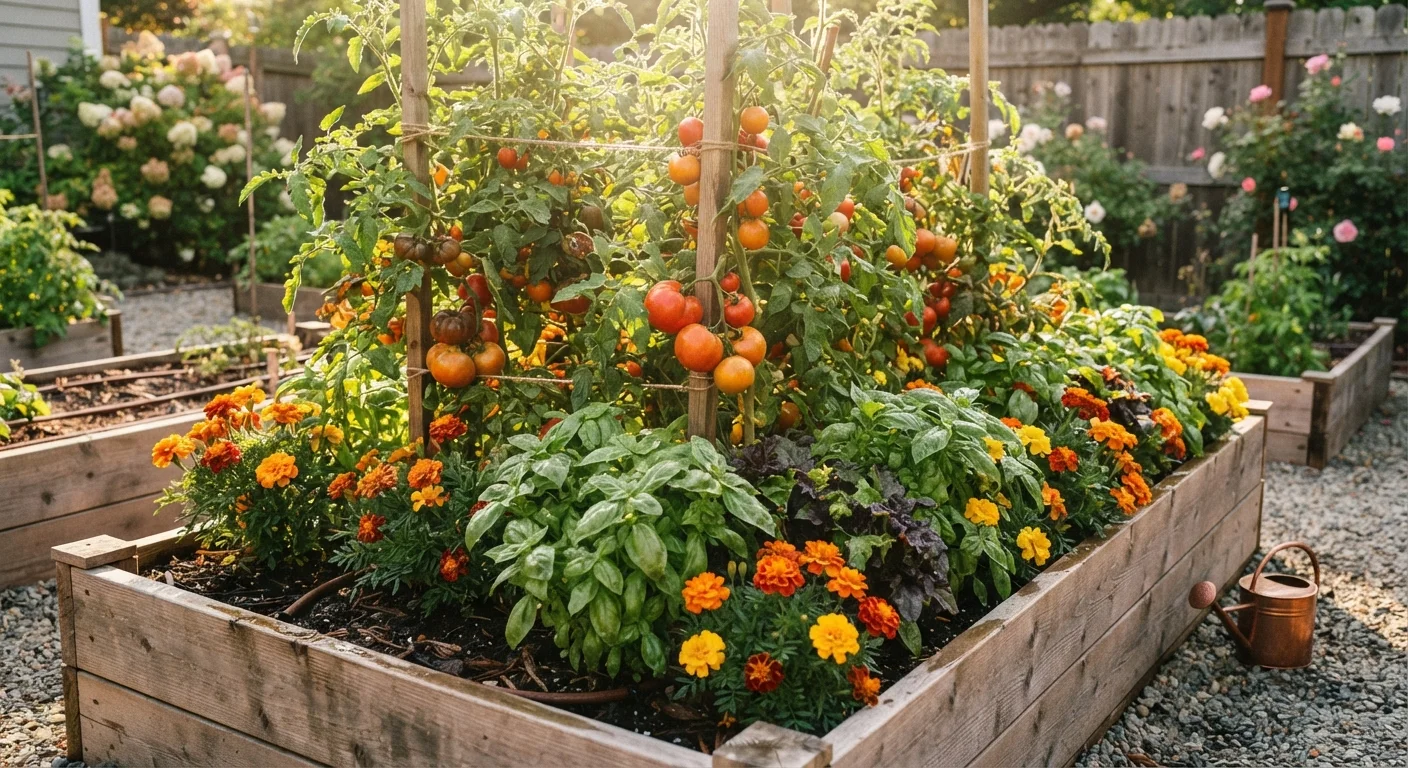
What Companion Planting Actually Claims to Do
Companion planting is the practice of growing different plants in close proximity so that one or both benefit — through pest deterrence, pollinator attraction, soil enrichment, or physical support. The concept is ancient and spans many cultures, from Indigenous American polyculture to European cottage gardening traditions.
The challenge is that garden advice gets passed along for generations without rigorous testing. Some combinations have real horticultural science behind them; others are repeated because they sound plausible. Before you rearrange your beds around a pairing you read on a seed packet, it helps to know which claims hold up.
If you're building a garden from the ground up, our guide to starting a vegetable garden from scratch walks through site selection and bed preparation before you start thinking about plant neighbors.
Myth
Planting marigolds anywhere in the garden will keep pests away from all nearby vegetables.
Fact
Marigolds deter specific pests — particularly root-knot nematodes and whiteflies — when the right species are used in meaningful quantities near susceptible plants.
French marigolds (Tagetes patula) have been shown in controlled studies to suppress soil-dwelling root-knot nematodes when planted densely as a cover crop or border, but the benefit diminishes with sparse planting. Whitefly deterrence requires the marigolds to be directly interplanted within the target crop, not simply placed at the perimeter. African marigolds (Tagetes erecta) show different effects. The blanket advice to "just add marigolds" glosses over species differences, planting density, and which specific pests you're actually dealing with.
Myth
Tomatoes and basil planted together will make tomatoes taste better.
Fact
There is no reliable scientific evidence that basil improves tomato flavor when grown nearby; tomato flavor is determined by genetics, soil nutrients, water, and sunlight.
This pairing is one of the most repeated in gardening culture, but taste improvement from proximity has not been demonstrated in peer-reviewed research. Basil can offer modest pest-deterrence benefits due to its aromatic volatile compounds, and the two plants do share similar growing conditions — full sun, warm temperatures, regular water — which makes them easy to manage together. Grow them together if you enjoy both crops, but set aside expectations of a flavor dividend.
Myth
Fennel is a great companion plant that benefits most vegetables.
Fact
Fennel is allelopathic — it releases chemicals that inhibit the growth of many common vegetables and should generally be grown in isolation or at the garden's edge.
Allelopathy is the process by which a plant releases chemical compounds (through roots, leaves, or decomposing matter) that suppress the germination or growth of nearby plants. Fennel is a well-documented example: research has shown it suppresses tomatoes, peppers, beans, and many herbs when grown in close proximity. The only common companions that tolerate fennel reasonably well are dill and other members of the carrot family — and even dill should not be placed too close, as the two can cross-pollinate. Keep fennel separated from your main vegetable beds.
Myth
The Three Sisters combination works in any garden bed regardless of size or spacing.
Fact
The Three Sisters system requires adequate space and correct timing to function well; cramped beds or poorly timed planting undermine all three crops.
The Three Sisters is genuinely effective, but it is designed for larger planting blocks — traditionally hills spaced several feet apart — where corn can reach adequate height before beans begin to climb, and where squash has room to sprawl without smothering shorter plants. In a small raised bed, the corn may not achieve effective pollination (corn is wind-pollinated and needs block planting rather than single rows), the beans may outcompete the corn for light, and the squash can overtake everything. Scale and timing matter as much as the pairing itself.
Myth
Planting garlic near roses prevents all aphid infestations.
Fact
Garlic may offer some repellent effect on certain insects, but it is not a reliable standalone solution for aphid control on roses.
The garlic-and-roses pairing has a long history in cottage gardening lore. Garlic does contain sulfur compounds that some insects find aversive, and there is limited evidence of a modest repellent effect. However, aphid populations are influenced by many factors — including the presence of ants (which farm aphids), natural predator populations such as ladybugs, and plant health overall. Relying solely on garlic as a companion while neglecting other integrated pest management steps is unlikely to prevent heavy infestations during peak aphid season.
Pairings With Real Evidence Behind Them
The most documented companion system is the Three Sisters — corn, climbing beans, and squash — practiced by many Indigenous peoples of North America for centuries. Corn provides a trellis for beans; beans fix atmospheric nitrogen that feeds the corn and squash; squash leaves shade the soil, suppressing weeds and retaining moisture. University extension research has repeatedly confirmed the yield and soil benefits of this system when planted at appropriate densities.
Another well-supported pairing is basil alongside tomatoes. While the flavor-enhancement claim is anecdotal and unproven, studies have found that basil's volatile oils can repel thrips and aphids. The benefit is modest and depends on basil being planted densely enough to matter — one small pot at the end of a long tomato row is unlikely to have meaningful effect.
Nasturtiums as trap crops near brassicas also has credible support. Aphids are strongly attracted to nasturtiums and will colonize them preferentially, drawing pests away from cabbages and kale. This works best when you monitor the nasturtiums and remove heavily infested growth rather than letting aphid colonies spread.
3,000+
Years the Three Sisters system has been cultivated
Archaeological and ethnohistorical records document the Three Sisters polyculture across Indigenous North American agricultural traditions spanning millennia.
Up to 60%
Nematode reduction with dense French marigold cover cropping
University extension trials have documented significant root-knot nematode suppression when French marigolds are grown as a full-season cover crop before susceptible vegetables.
Getting your soil conditions right matters as much as any pairing strategy. See our article on soil pH and why your plants keep struggling for a practical primer.
When to Question the Pairing Advice
Not every classic combination delivers what gardeners expect. Understanding why helps you make smarter decisions in your own yard.
Don't Let Companion Planting Replace Spacing Rules
Crowding plants together in the name of companion planting can increase humidity around foliage, promoting fungal diseases like powdery mildew and botrytis. Always check mature spread dimensions before interplanting, and prioritize air circulation. A companion that causes disease pressure is doing more harm than good.
Companion planting is one layer of good garden practice, not a substitute for fundamentals like consistent watering, healthy soil, and correct spacing. Our article on watering habits that quietly damage gardens covers some of the most common ways gardeners undermine healthy plants before pest pressure even enters the picture.
For a broader seasonal view of what your garden needs month by month, the seasonal garden task checklist is a reliable reference to keep nearby.
Soil Health Comes Before Plant Pairings
No companion planting strategy compensates for depleted, compacted, or pH-imbalanced soil. Before rearranging your planting scheme, test your soil and address deficiencies. Companion planting works best as an enhancement to an already well-maintained growing environment — not as a fix for underlying soil problems.
The content provided on our blog site traverses numerous categories, offering readers valuable and practical information. Readers can use the editorial team’s research and data to gain more insights into their topics of interest. However, they are requested not to treat the articles as conclusive. The website team cannot be held responsible for differences in data or inaccuracies found across other platforms. Please also note that the site might also miss out on various schemes and offers available that the readers may find more beneficial than the ones we cover.