

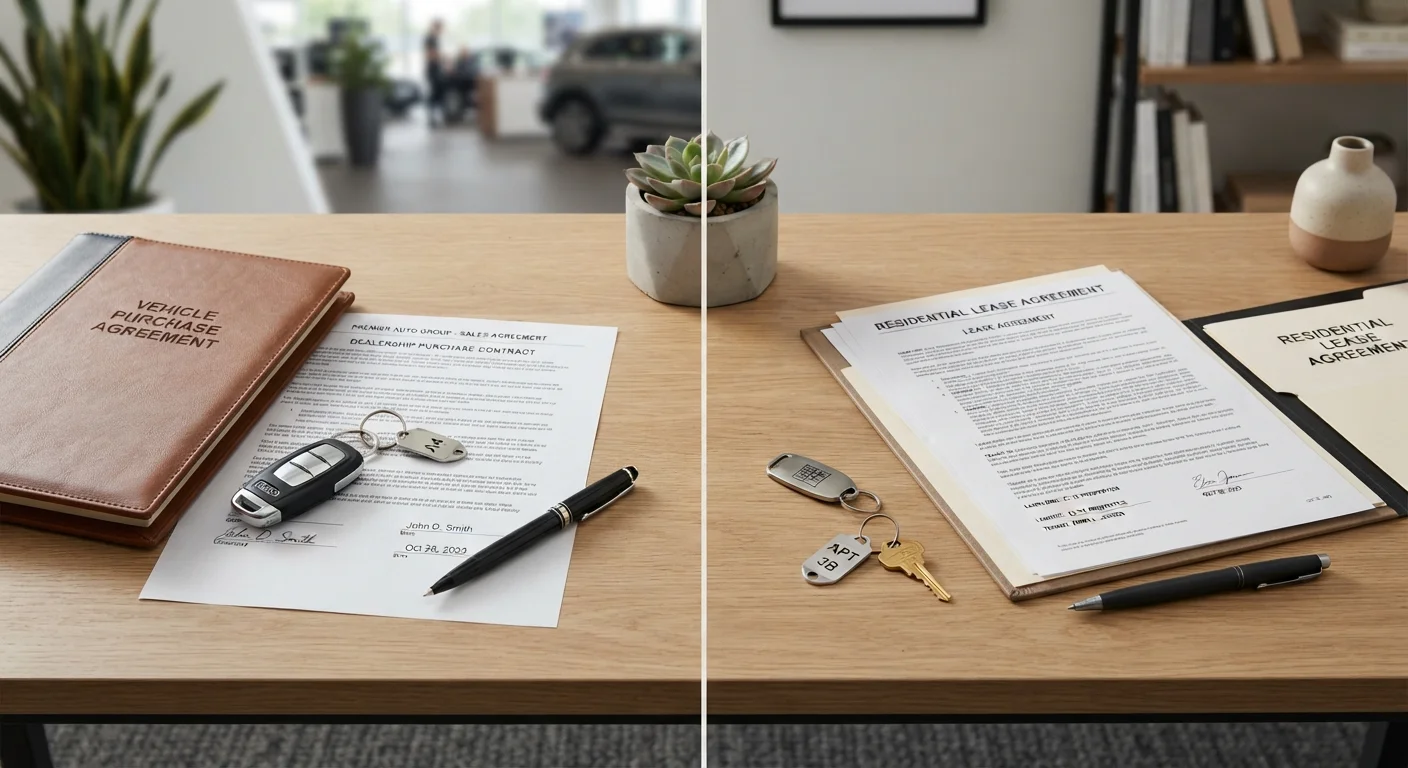
Option A
Financing (Auto Loan)
The path to full ownership over time.
Best for: Drivers who want to build equity, drive without mileage limits, and keep the vehicle long-term.
Option B
Leasing
Lower monthly payments in exchange for temporary use.
Best for: Drivers who prefer newer vehicles every few years and keep annual mileage within set limits.
How Each Arrangement Works
When you finance a vehicle, a lender — a bank, credit union, or dealership-affiliated finance company — pays the purchase price, and you repay that amount plus interest over a set term, typically 36 to 72 months. Each payment reduces what you owe (principal) and covers interest. Once the final payment clears, you hold the title and own the vehicle outright.
When you lease a vehicle, you're essentially renting it from the leasing company (often the automaker's financial arm) for an agreed term, usually 24 to 36 months. Payments cover the vehicle's projected depreciation during that period — not its full value — plus fees and a money factor (the lease equivalent of an interest rate). At lease-end, you return the vehicle or, in some cases, exercise a purchase option at a predetermined residual value.
Understanding how loans and credit work is useful groundwork before signing either type of agreement, since your credit score directly shapes the interest rate or money factor you'll be offered.
| Criterion | Financing (Auto Loan) | Leasing |
|---|---|---|
| Ownership | You own after final payment | Lessor retains ownership |
| Monthly payment | Higher (full value + interest) | Lower (depreciation + fees) |
| Mileage limits | None | Typically 10,000–15,000/year |
| Customization | Permitted | Restricted; must return stock |
| End-of-term options | Keep, sell, or trade | Return or buy at residual |
| Early exit | Sell or refinance | Costly early termination fees |
| Long-term cost | Lower after loan payoff | Ongoing payments if always leasing |
| Equity building | Yes | No |
Costs: What You Actually Pay
The sticker price is only the starting point. Under a loan, you pay the vehicle's full negotiated price (minus any down payment) plus accumulated interest. A higher down payment reduces the amount financed and the total interest paid. For a full picture of what ownership entails beyond monthly payments, see the true cost of car ownership.
Lease costs are structured differently. Your monthly payment reflects the capitalized cost (the agreed vehicle price), the residual value (what the car is projected to be worth at lease-end), and the money factor. A higher residual value means lower payments, which is why vehicles with strong resale retention tend to lease favorably. Depreciation works against financed buyers too, but unlike lessees, owners can recoup some value when they sell or trade in.
~30%
Average vehicle value lost in first year
Industry estimates suggest most new vehicles lose roughly 20–30% of their value within the first 12 months of ownership, a key factor in lease residual calculations.
69 months
Average new-car loan term (U.S.)
According to Experian's State of the Automotive Finance Market reports, average new vehicle loan terms have steadily extended toward and beyond 60 months in recent years.
~30%
Share of new vehicles leased in the U.S.
Leasing has historically accounted for roughly a quarter to a third of new vehicle transactions, though the share fluctuates with interest rates and incentive programs.
Lease agreements also carry potential end-of-term charges: excess mileage fees (commonly $0.15–$0.25 per mile over the cap), disposition fees, and wear-and-tear assessments. These can materially affect the true cost of a lease if you're not attentive throughout the term.
Ownership, Flexibility, and the Long View
The most fundamental difference is ownership. A financed vehicle is an asset — albeit a depreciating one — that you can sell, trade, modify, or keep indefinitely. A leased vehicle is always someone else's property. You cannot sell it, and customizing it risks penalty charges on return.
Financing also offers more flexibility mid-term. If your circumstances change, you can sell the vehicle (though negative equity — owing more than the car is worth — complicates this). Early lease termination is costly, often requiring you to cover remaining payments plus termination fees.
Early Lease Termination: Proceed with Caution
Exiting a lease before the agreed term ends typically triggers significant charges, which can include all remaining monthly payments, an early termination fee, and any outstanding fees for excess mileage or wear. Some drivers transfer their lease to another party through a lease-assumption service, which can reduce costs, but terms vary by leasing company and not all permit it. Always read the termination clauses carefully before signing.
On the other hand, leasing removes the uncertainty of what to do with an aging vehicle. At term-end, you return it and choose your next vehicle without navigating a private sale or trade-in negotiation. For drivers whose needs shift frequently or who value predictable short-term costs, that simplicity carries real weight.
If managing debt obligations is already a consideration in your household, reviewing strategies from resources like debt repayment approaches can help you contextualize how an auto loan fits within your broader financial picture.
The content provided on our blog site traverses numerous categories, offering readers valuable and practical information. Readers can use the editorial team’s research and data to gain more insights into their topics of interest. However, they are requested not to treat the articles as conclusive. The website team cannot be held responsible for differences in data or inaccuracies found across other platforms. Please also note that the site might also miss out on various schemes and offers available that the readers may find more beneficial than the ones we cover.