

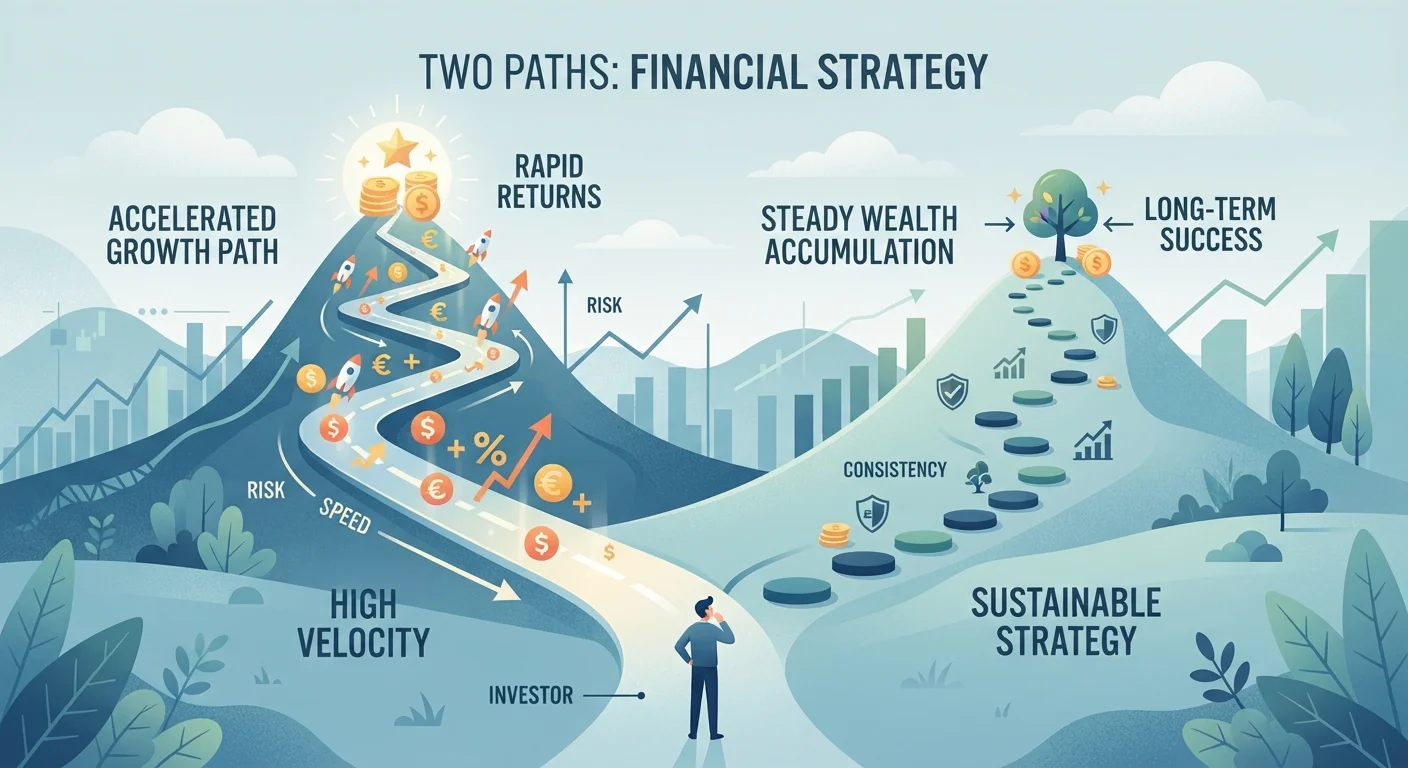
Our Verdict
Both strategies are effective tools for paying down debt — the debt avalanche saves more money in interest over time, while the debt snowball builds psychological momentum through early wins. Neither is universally superior; the right choice depends on how you're motivated and the structure of your debts.
| Best for | Recommended |
|---|---|
| Those focused on minimizing total interest paid | Debt Avalanche |
| Those who need early wins to stay motivated | Debt Snowball |
| Those with many small balances to clear quickly | Debt Snowball |
| Those with high-APR debt as a dominant balance | Debt Avalanche |
The Core Idea Behind Both Methods
Both the debt avalanche and debt snowball are structured repayment strategies built on the same mechanical foundation: you make minimum payments on all your debts, then direct any extra money each month toward one specific target debt. When that debt is eliminated, you roll its former payment into the next target — a process sometimes called a "debt rollover."
Where the two strategies diverge is in how they rank which debt to target first. That single difference has meaningful financial and psychological consequences. If you're new to credit and debt fundamentals, start with the basics before choosing a strategy.
Make Sure You Have a Starter Emergency Fund
Before aggressively targeting debt, many financial counselors suggest setting aside a small emergency fund — often $500 to $1,000 — so that an unexpected expense doesn't force you back into high-interest borrowing. This buffer helps keep your repayment plan intact when life doesn't go according to plan. Building a solid budget foundation alongside your repayment strategy strengthens both.
How the Debt Avalanche Works
The debt avalanche prioritizes the debt with the highest annual percentage rate (APR) — regardless of the balance size. By attacking the most expensive debt first, you reduce the amount of interest accruing across your overall debt load as quickly as possible.
Consider a simplified example: if you have a credit card at 24% APR, a personal loan at 14%, and a car loan at 6%, the avalanche method directs extra payments to the credit card first. Once it's gone, you move to the personal loan, and so on.
The advantage: You pay less in total interest over the life of your debts. For people with high-interest balances — particularly credit card debt — the savings can be substantial.
The challenge: If your highest-APR debt also carries a large balance, it can take a long time before you see your first account eliminated. That delay can erode motivation. Understanding how certain financial habits quietly affect your credit can add additional context to why keeping high-APR balances low matters.
~20%
Average credit card APR in the U.S.
The Federal Reserve has reported average credit card interest rates consistently above 20% in recent years, underscoring the cost of carrying high-APR balances.
3 in 4
Americans carrying some form of debt
Federal Reserve data indicates that the vast majority of U.S. households carry at least one form of debt, from mortgages to credit cards to student loans.
How the Debt Snowball Works
The debt snowball prioritizes the debt with the smallest balance — regardless of interest rate. The goal is to eliminate individual accounts quickly, generating a sense of progress and momentum.
Using the same example: you'd target the car loan first (assuming it has the smallest balance), then the personal loan, then the credit card — even though the credit card is costing you the most in interest.
The advantage: Behavioral research consistently suggests that early wins help people sustain effort on long-term goals. Eliminating a debt account entirely — and freeing up its minimum payment — can feel rewarding in a way that encourages continued commitment.
The challenge: You will likely pay more in total interest compared to the avalanche method, sometimes significantly so, depending on the APR difference between your smallest and largest balances.
| Debt Avalanche | Debt Snowball | |
|---|---|---|
| Target selection | Highest APR first | Smallest balance first |
| Total interest paid | Lower over time | Potentially higher |
| Speed of first payoff | Slower if high-APR debt is large | Faster — smallest balance cleared first |
| Psychological motivation | Reward comes later | Early wins build momentum |
| Best suited for | Analytical, numbers-driven personalities | Those who need visible progress |
| Mathematical efficiency | Higher — minimizes interest cost | Lower — prioritizes speed of account closure |
Choosing the Strategy That Fits You
The most effective debt repayment strategy is the one you'll actually follow through on. Research in behavioral economics suggests that motivation and consistency matter as much as mathematical optimization when it comes to paying down debt. A plan abandoned halfway through costs more than a slightly less efficient plan completed in full.
Ask yourself a few practical questions:
- Do you tend to get discouraged when progress is slow? The snowball may suit you better.
- Are you driven by numbers and efficiency? The avalanche may keep you engaged.
- Is one debt significantly more expensive than the others? The avalanche likely makes the most financial sense.
- Do you have several small balances cluttering your finances? The snowball can simplify your picture quickly.
If you're managing debt alongside broader budget pressures, it also helps to understand where household budgets tend to break down so you can build a plan that doesn't collapse at the first obstacle. For context on how different types of debt behave, understanding secured versus unsecured debt can sharpen your strategy further.
Don't Skip Minimums on Other Debts
A common mistake when implementing either strategy is neglecting minimum payments on non-target debts in order to pay more toward the priority account. Missing minimum payments triggers late fees, potential penalty APRs, and credit score damage — costs that typically outweigh any short-term repayment gain. Always pay minimums on every account before directing extra funds to your target debt.
This article is for general informational and educational purposes only and does not constitute personalized financial or legal advice. Consult a licensed financial professional for guidance specific to your situation.
The content provided on our blog site traverses numerous categories, offering readers valuable and practical information. Readers can use the editorial team’s research and data to gain more insights into their topics of interest. However, they are requested not to treat the articles as conclusive. The website team cannot be held responsible for differences in data or inaccuracies found across other platforms. Please also note that the site might also miss out on various schemes and offers available that the readers may find more beneficial than the ones we cover.