

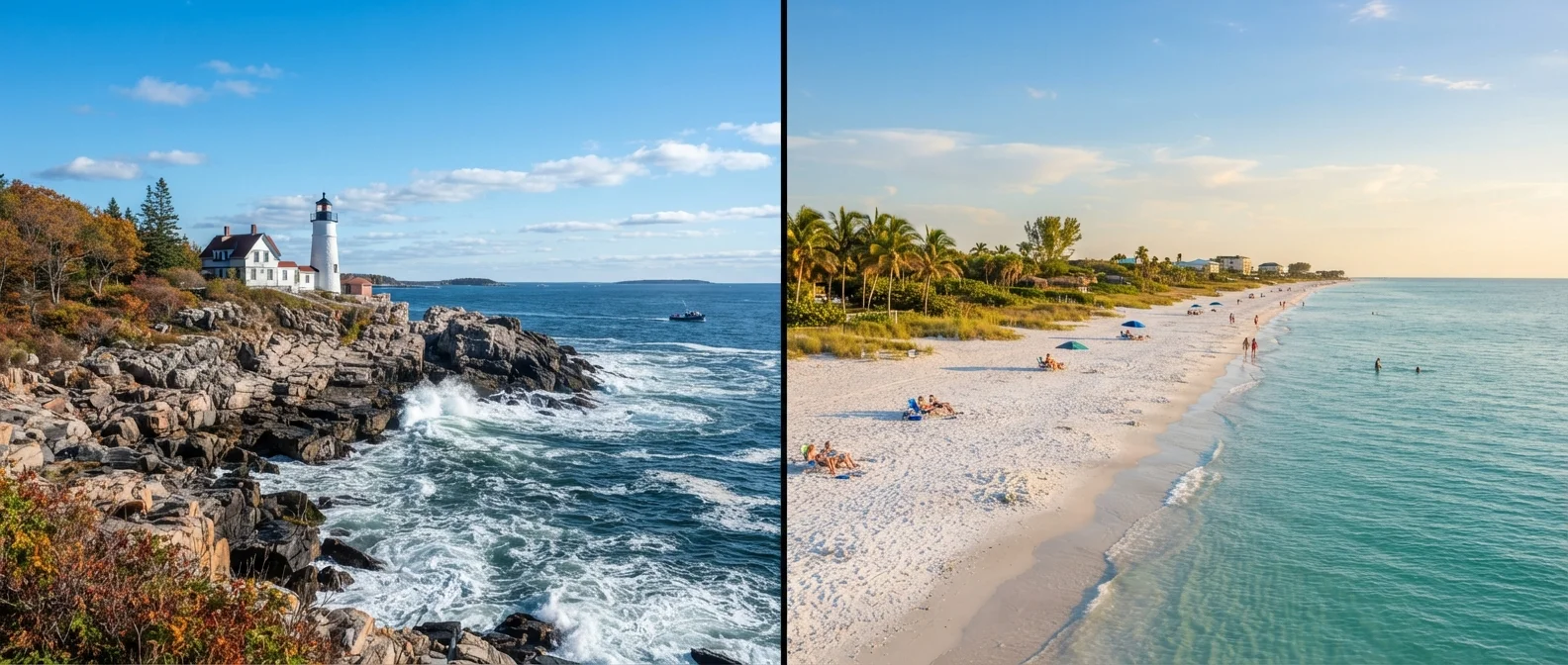
Option A
Coastal New England
The rugged, history-soaked northeastern shore.
Best for: Travelers who love maritime history, seafood culture, dramatic scenery, and cooler summer escapes.
Option B
The Gulf Coast
The warm, laid-back southern shoreline.
Best for: Travelers seeking warm water, white-sand beaches, mild winters, and a relaxed coastal pace.
The Character of Each Coast
America's two most celebrated coastal stretches couldn't feel more different underfoot. Coastal New England — stretching from Connecticut's shoreline through Rhode Island, Massachusetts, New Hampshire, and Maine — is a landscape of granite headlands, lobster traps stacked on weathered docks, and white-steepled towns that date to the colonial era. The ocean here is cold, the tides are dramatic, and the light in late afternoon turns everything amber and cinematic.
The Gulf Coast, running from Florida's Panhandle through Alabama, Mississippi, Louisiana, and Texas, is something else entirely. The water is warm and shallow, the sand in some stretches (particularly around the Panhandle) is startlingly white and soft underfoot. The pace is slower and the culture is a rich blend of Cajun, Creole, Indigenous, and Southern influences that show up in the food, music, and architecture as much as the scenery.
Neither is objectively better — they're genuinely different kinds of trips. Understanding that difference is the best starting point for planning. For a broader view of how US regions shift by season, see our region-by-region seasonal overview.
| Criterion | Coastal New England | The Gulf Coast |
|---|---|---|
| Best travel season | Late June – early October | November – March |
| Water temperature | Cold (50s–60s°F in summer) | Warm (70s–80s°F year-round) |
| Beach type | Rocky, dramatic, rugged | Wide, sandy, calm and shallow |
| Signature food | Lobster, clam chowder, oysters | Gumbo, po'boys, Gulf shrimp |
| Major natural draw | Acadia National Park, Cape Cod | Gulf Islands National Seashore |
| Hurricane risk | Low | High (June–November) |
| Cultural anchor city | Portland, ME or Boston, MA | New Orleans, LA |
| Crowd intensity | High July–August | High winter (FL Panhandle) |
Climate and Timing: When to Go
Timing your trip to either coast shapes everything — what you'll wear, how crowded it is, and what activities are actually viable.
New England comes alive from late June through early October. Summer brings mild temperatures (typically 70s°F along the shore), reliable sunshine, and full access to every lobster shack, whale-watching boat, and hiking trail. September and early October add a spectacular bonus: fall foliage creeping toward the coast. The trade-off is that this peak window is also the most crowded and expensive. Off-season visits (spring, late fall) are quieter and authentically local, but some seasonal businesses close.
The Gulf Coast flips the script. Winter (November–March) is prime time — warm, sunny, and far less humid than summer. Spring brings wildflowers along the coastal marshes and good birding. Summer is hot, extremely humid, and sits squarely inside hurricane season (June–November), which introduces real uncertainty into travel plans. That said, popular destinations like the Florida Panhandle do see heavy summer family traffic, so it's not impossible — just more demanding.
40 miles
Undisturbed shoreline at Cape Cod National Seashore
The Cape Cod National Seashore protects approximately 40 miles of Atlantic coastline in Massachusetts, one of the longest preserved stretches in the Northeast.
~80°F
Average Gulf water temperature in winter
Gulf of Mexico surface water temperatures in the southern reaches remain relatively warm even in winter months, drawing cold-weather travelers from northern states.
6
States along the Gulf Coast
The US Gulf Coast spans Florida, Alabama, Mississippi, Louisiana, and Texas — five states with distinct regional cultures tied together by the same warm sea.
What to Do: Experiences Compared
The activities each coast does best reflect their underlying character.
In New England, the draws are layered. Acadia National Park in Maine offers world-class hiking with ocean views; the Cape Cod National Seashore preserves forty miles of nearly undisturbed Atlantic shoreline. Newport, Rhode Island delivers Gilded Age mansions alongside working fishing harbors. Portland, Maine has become a serious food city with a compact, walkable downtown. History is woven into everything — Plymouth, Salem, and Gloucester all carry stories that predate the American Revolution.
On the Gulf Coast, the signature experiences are more spread out. New Orleans stands apart as one of the most culturally dense cities in the country — jazz, architecture, cuisine, and festival culture unlike anywhere else in America. The Gulf Islands National Seashore (shared between Florida and Mississippi) protects some of the most pristine barrier-island beaches on the continent. Padre Island National Seashore in Texas is one of the longest undeveloped barrier islands in the world. And the bayou country of southern Louisiana rewards slower exploration by boat or car.
Both coasts also have genuinely underrated stretches. Our guide to lesser-known US cities worth building a trip around highlights spots like Portsmouth, NH and Mobile, AL — both coastal, both overlooked, both worth your time.
A Note on Hurricane Season Planning
The Atlantic hurricane season runs June 1 through November 30, and the Gulf Coast sits squarely in its path. This doesn't mean travel is impossible during those months, but it does mean travelers should monitor forecasts closely, understand their accommodation's cancellation policies, and consider travel insurance. Always check the National Hurricane Center (nhc.noaa.gov) for current conditions before and during Gulf Coast travel in the summer and fall.
How to Plan Your Trip
Both coastlines reward road-trip-style exploration rather than planting yourself in one resort for a week. For New England, a logical route strings together Portland → Kennebunkport → Portsmouth → Gloucester → Cape Cod, with side trips inland possible at almost every stop. Distances are short and infrastructure is strong.
Gulf Coast road trips cover more ground by necessity — the coastline spans several states, and cities like New Orleans and Houston are hours apart. That said, the drives themselves are often beautiful, especially along Highway 90 through Mississippi and the Gulf Islands Scenic Byway in Florida. See our road trip planning guide for help thinking through daily mileage and logistics realistically.
Whichever coast you choose, resist the urge to overpack your itinerary. Coastal travel especially rewards having unscheduled time — a long lunch that turns into a sunset, a kayak rental, a market you didn't plan for. Our guide to building a travel itinerary that actually works can help you find that balance.
Travel conditions, entry requirements, and local regulations can change. Always verify current information with official sources before you travel.
The content provided on our blog site traverses numerous categories, offering readers valuable and practical information. Readers can use the editorial team’s research and data to gain more insights into their topics of interest. However, they are requested not to treat the articles as conclusive. The website team cannot be held responsible for differences in data or inaccuracies found across other platforms. Please also note that the site might also miss out on various schemes and offers available that the readers may find more beneficial than the ones we cover.