

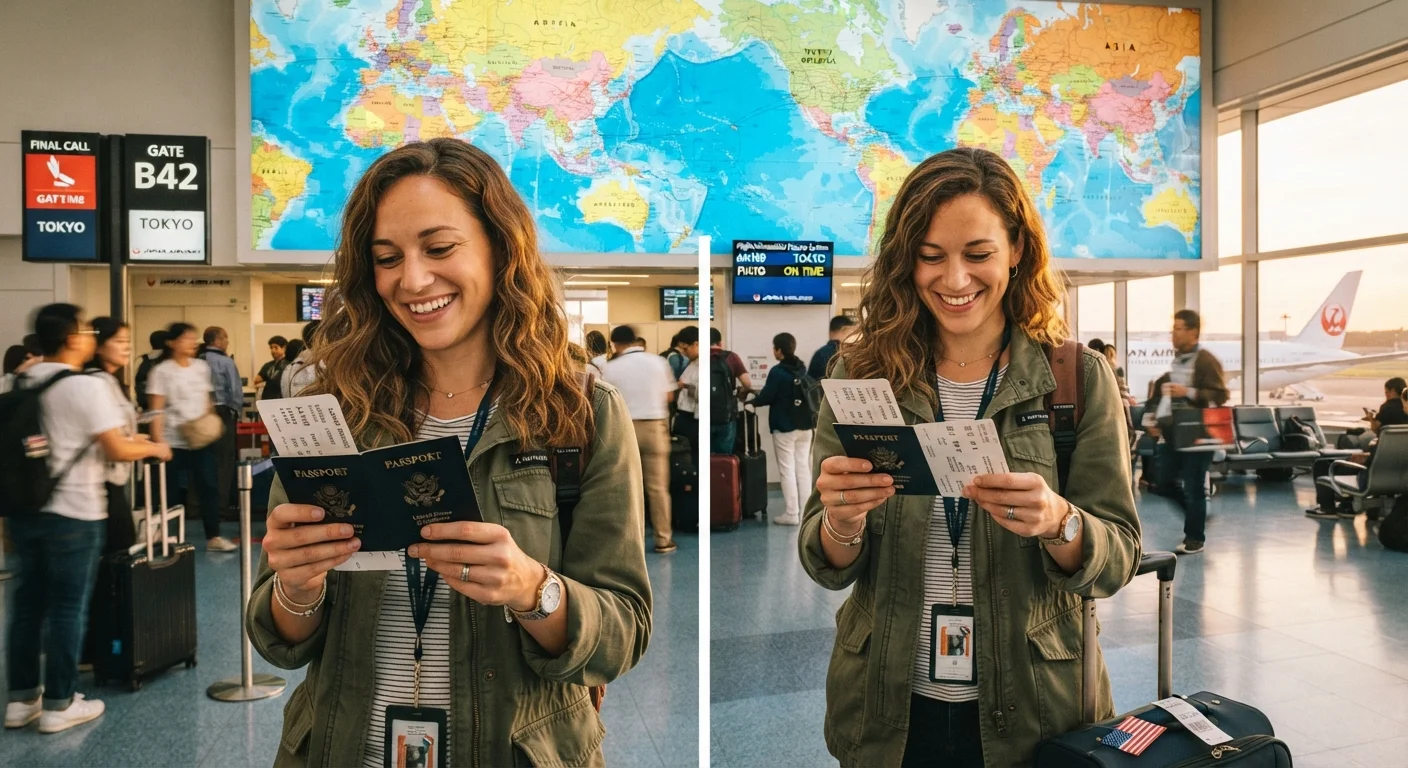
Why American Travelers Trip Up Abroad
International travel is one of the most rewarding things you can do — and one of the easiest to underestimate. Americans take more than 90 million international trips annually, yet a surprisingly large number of those journeys run into friction that was entirely preventable. The culprit is rarely a lack of enthusiasm. It's a set of deeply ingrained assumptions about how the world works — assumptions shaped by traveling in a country where the rules, the currency, the language, and the customs are already second nature.
Going abroad means stepping out of that comfort zone in very practical ways. Whether you're heading to Europe, Southeast Asia, Latin America, or anywhere in between, the mistakes below consistently catch US travelers off guard. Knowing them in advance is your best defense. For a full pre-trip framework, our first international trip guide covers passports, visas, money, and cultural prep in one place.
Assuming a valid passport is all you need to enter any country.
Why it happens: Within the US, a passport is essentially a universal key — travelers don't think much beyond having one. Many don't know that destination countries often impose additional requirements like visas, tourist cards, or minimum validity windows.
Using a US credit or debit card abroad without notifying the bank or checking for foreign transaction fees.
Why it happens: Cards work seamlessly across the US, so travelers assume the same applies internationally. Many don't realize banks may freeze cards flagged for unusual foreign activity, or that foreign transaction fees of 1–3% quietly add up.
Tipping at US rates in countries where it's not customary — or not tipping where it's expected.
Why it happens: Tipping norms in the US are so ingrained that travelers simply apply them everywhere without questioning whether they translate.
Packing prescription medications without checking import rules or carrying documentation.
Why it happens: Travelers assume that a legal US prescription automatically grants global permission to carry the medication. Some controlled substances in the US are banned outright in other countries.
Underestimating jet lag and its effect on the first few days of a trip.
Why it happens: Travelers optimize their itineraries for activities and sightseeing without accounting for how significantly crossing multiple time zones affects sleep, judgment, and energy.
Assuming English will be spoken and understood everywhere.
Why it happens: English is widely used in international tourism contexts, which creates the impression it's universally available. In rural areas or smaller towns, this often isn't true.
Before You Go: Documents, Money, and Logistics
The mistakes that sting most are the ones that happen before you ever board the plane — and the majority are documentation or financial in nature.
6 months
Passport validity required by many countries beyond travel dates
A number of popular destinations, including several in Southeast Asia and the Middle East, deny entry if your passport expires within six months of your arrival date.
1–3%
Typical foreign transaction fee per card purchase abroad
Many standard US bank cards charge a foreign transaction fee on every international purchase, a cost that's easy to overlook when budgeting for a trip.
~40%
Americans who hold a valid US passport
According to US State Department data, roughly 40% of Americans have a valid passport, meaning a significant share of potential international travelers aren't yet document-ready.
Passport validity is the classic trap. Many countries require that your passport remain valid for at least six months beyond your travel dates. A passport that's technically current may still get you denied boarding. Check your passport expiration date the moment you start planning, not the week before departure.
On the money side, assumptions about card acceptance and ATM access cause real headaches. Some regions are still heavily cash-based. Others will charge steep fees for foreign transactions or apply unfavorable dynamic currency conversion rates at the point of sale. Our guide on managing money internationally breaks down exactly how to avoid losing cash to avoidable charges. Also worth reading: why travel budgets fall apart — because foreign fees are often the first crack.
Don't Rely on Airport Currency Exchange
Airport currency exchange booths are typically among the least favorable places to convert money, with wide spreads between buy and sell rates. Research your options — local ATMs at your destination or a travel-specific card — before you land. See our guide on handling foreign currency for a fuller picture of the tradeoffs.
Always verify entry requirements directly with the official embassy or consulate of your destination country before traveling. Requirements change, and third-party websites can be outdated.
On the Ground: Cultural and Safety Missteps
Once you've landed, a new set of assumptions can get you into trouble — social, legal, or logistical. Tipping culture is a prime example: in the US, tipping 18–20% is standard and expected. In Japan, tipping can be considered rude. In many European countries, rounding up or leaving small change is the norm. Applying American tipping logic globally creates awkward moments at best and genuine offense at worst.
Local Laws Apply to You — Fully
The US Embassy cannot get you out of legal trouble for breaking a foreign country's laws, even if those laws differ significantly from US norms. Ignorance of local law is rarely a valid legal defense abroad. Research the specific legal rules of your destination — including rules around photography, alcohol, dress codes in religious sites, and any medications you're carrying — well before you travel.
Equally important is treating local laws as equivalent to US laws. They aren't. Prescription medications that are legal in the US may be controlled substances abroad. Photography restrictions in some countries are strictly enforced. Traffic laws, alcohol regulations, and even chewing gum rules (looking at you, Singapore) differ meaningfully. Research specific local rules for your destination — not just the fun stuff.
Safety prep is another gap. Many American travelers skip registering with the US State Department's Smart Traveler Enrollment Program (STEP), which is free and connects you with your nearest embassy in an emergency. Our full breakdown of practical safety habits abroad is worth a read before any international trip. And before you leave home, run through the international travel checklist to make sure nothing critical slips through the cracks.
The content provided on our blog site traverses numerous categories, offering readers valuable and practical information. Readers can use the editorial team’s research and data to gain more insights into their topics of interest. However, they are requested not to treat the articles as conclusive. The website team cannot be held responsible for differences in data or inaccuracies found across other platforms. Please also note that the site might also miss out on various schemes and offers available that the readers may find more beneficial than the ones we cover.