

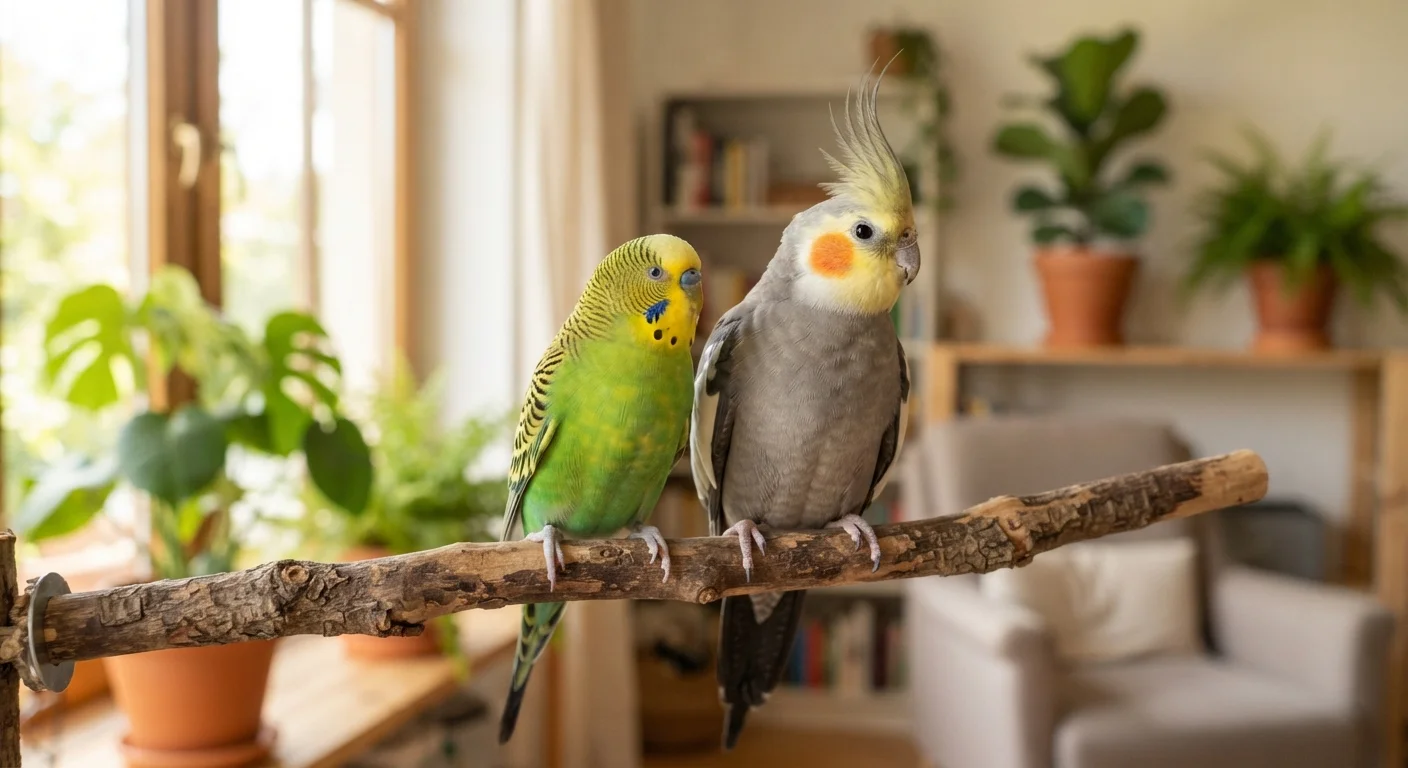
Option A
Budgerigar (Budgie)
The compact, lively starter bird.
Best for: First-time bird owners or those with limited space who want an active, social companion.
Option B
Cockatiel
The affectionate, expressive medium-sized parrot.
Best for: Owners seeking a hands-on bond with a bird that thrives on daily interaction and gentle handling.
Size, Lifespan, and What to Expect Long-Term
Before choosing between a budgie and a cockatiel, it helps to understand what you're committing to in practical terms. Budgies (also called budgerigars or parakeets) are small birds — typically 6–7 inches from beak to tail — and weigh only around 1 ounce. Cockatiels are noticeably larger at 12–13 inches and 2.5–3.5 ounces, placing them in the small-to-medium parrot category.
Lifespan is one of the most significant differences. A healthy budgie generally lives 7–12 years. Cockatiels, given proper nutrition, veterinary care, and a stimulating environment, commonly reach 15–20 years. That's not a small distinction — adopting a cockatiel is a commitment closer in length to owning a dog than caring for a hamster. Think honestly about your lifestyle over the coming decade before deciding. For a broader look at matching your life to a small pet, see this guide to choosing the right small pet.
15–20 yrs
Typical cockatiel lifespan with good care
Cockatiels are one of the longest-lived small companion birds, according to general avian veterinary guidance.
7–12 yrs
Typical budgie lifespan
Budgies kept on balanced diets with regular veterinary care tend to live toward the higher end of this range.
~1 oz
Average adult budgie weight
Their small size makes budgies one of the most space-efficient pet bird options for apartment dwellers.
Noise, Temperament, and Social Needs
Both species are social birds that should not be housed in isolation, but they express that sociability differently. Budgies are constantly chattering — a cheerful, bubbling stream of chirps and mimicked sounds. The volume is relatively low, making budgies more apartment-friendly. Cockatiels produce louder, more musical whistles and contact calls. A cockatiel left alone or under-stimulated will vocalize insistently until it gets attention.
Temperamentally, cockatiels are often described as more openly affectionate. They seek out their owners, enjoy being perched on a shoulder, and respond visibly to interaction. Budgies can bond closely with people, but they're more likely to be content entertaining themselves or a companion bird. If you want a bird that actively courts your company, a cockatiel may feel more rewarding. If you prefer a lively bird that doesn't demand constant attention, a budgie pair could be the better fit.
Single Bird or a Pair?
Budgies kept singly require significantly more human interaction to meet their social needs; a bonded pair reduces that pressure but may make the birds less focused on human contact. Cockatiels can thrive as single birds when their owner provides daily hands-on time, but can also be kept in pairs. Consider your availability honestly before deciding on a housing arrangement.
Handling, Taming, and Training
Cockatiels generally tame more readily than budgies. With consistent, gentle daily sessions, most hand-raised cockatiels learn to step up onto a finger, tolerate being held, and interact calmly. Budgies can absolutely be tamed — patience and repetition work — but they are quicker and more evasive by nature, which can make early training feel slower.
Both species benefit from learning simple behaviors like stepping up on command, which makes routine care (nail trims, vet exams) significantly easier. Neither bird should be grabbed or restrained forcefully; trust-based handling is essential for both. Plan for at least 30–60 minutes of out-of-cage time daily for either species. Understanding the realities of keeping a pet bird can help you prepare for those enrichment and handling demands before you bring one home.
Diet, Housing, and Veterinary Care
Both budgies and cockatiels thrive on a diet that goes beyond a seed-only mix. Avian veterinarians generally recommend a base of high-quality pellets supplemented with fresh vegetables, leafy greens, and limited fruit. Seeds can be offered in moderation but should not be the sole food source, as high-fat seed diets are linked to obesity and nutritional deficiency in both species.
Housing needs differ in scale. A budgie requires a cage that allows full wing extension and flight movement — wider is more important than taller. Cockatiels need a substantially larger enclosure. Both cages should be placed away from drafts, cooking fumes, and non-stick cookware (which releases fumes toxic to birds when overheated).
Find an avian-experienced veterinarian before you adopt, not after. Annual wellness exams are strongly recommended for both species. Because birds instinctively mask illness, subtle behavioral changes — reduced vocalization, fluffed feathers, changes in droppings — are often the earliest signs something is wrong. Prompt veterinary attention matters.
| Criterion | Budgie | Cockatiel |
|---|---|---|
| Average size | 6–7 inches, ~1 oz | 12–13 inches, 2.5–3.5 oz |
| Typical lifespan | 7–12 years | 15–20 years |
| Noise level | Constant chattering, low volume | Louder whistles and contact calls |
| Ease of taming | Possible but takes patience | Generally tames more readily |
| Affection toward owners | Can bond well, more independent | Actively seeks human interaction |
| Keeps well in pairs | Yes, thrives with a companion | Yes, but bonds closely to one person |
| Cage size needed | Moderate — wider is better | Large — ample flight space required |
| Diet complexity | Pellets, veggies, limited seeds | Pellets, veggies, limited seeds |
This article provides general educational information about pet bird care and is not a substitute for advice from a qualified avian veterinarian.
The content provided on our blog site traverses numerous categories, offering readers valuable and practical information. Readers can use the editorial team’s research and data to gain more insights into their topics of interest. However, they are requested not to treat the articles as conclusive. The website team cannot be held responsible for differences in data or inaccuracies found across other platforms. Please also note that the site might also miss out on various schemes and offers available that the readers may find more beneficial than the ones we cover.