

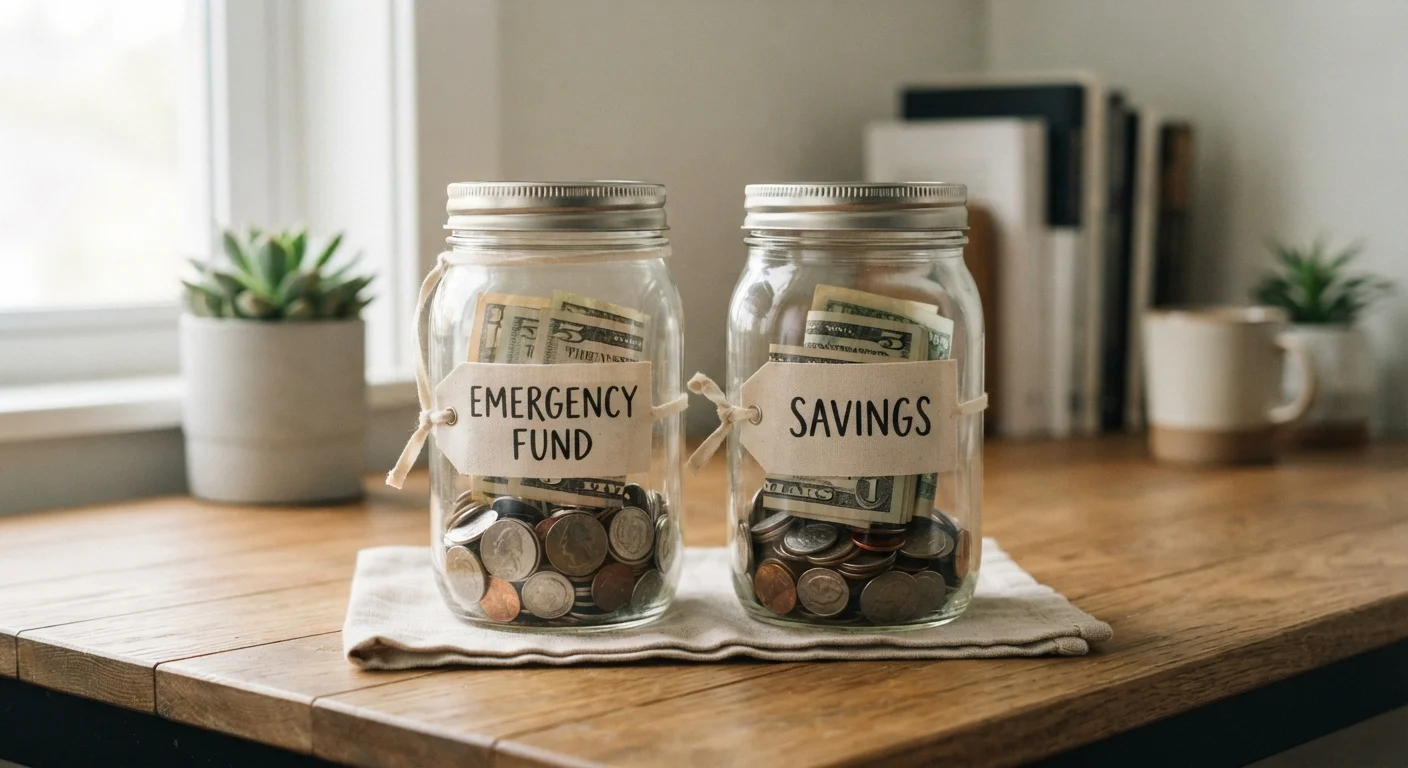
Option A
Emergency Fund
The untouchable financial safety net.
Best for: Covering true financial emergencies — job loss, medical bills, urgent car or home repairs — without disrupting your regular budget.
Option B
Everyday Savings
The flexible, goal-oriented savings pool.
Best for: Planned future expenses like vacations, appliances, holiday gifts, or any foreseeable purchase you're setting money aside for.
Why One Savings Account Is Not Enough
Many households operate with a single savings account intended to handle everything — a rainy-day cushion, a vacation fund, a new appliance budget, and a backup in case of job loss. On the surface, pooling money seems simpler. In practice, it creates ambiguity that leads to costly decisions.
When emergency money and goal-based savings share the same account, there is no clear psychological or structural boundary. A weekend trip becomes easy to justify because 'the money is there.' A job loss then reveals that the cushion you assumed existed has already been spent on planned, foreseeable purchases. Understanding what an emergency fund actually is — and what it is not — is the starting point for building this separation correctly.
Separate accounts create a visible, intentional structure. They make the purpose of each dollar explicit, which is one of the most effective ways to protect long-term financial health.
| Criterion | Emergency Fund | Everyday Savings |
|---|---|---|
| Primary purpose | Cover unexpected financial crises | Fund planned future expenses |
| Spending trigger | Unforeseeable, urgent need | Anticipated, planned purchase |
| Target amount | 3–6 months of essential expenses | Cost of specific goal(s) |
| Ideal account type | Separate high-yield savings account | Goal-labeled savings account or sub-account |
| Withdrawal frequency | Rarely — only in true emergencies | As goals are reached and money is needed |
| Psychological role | Financial security and stability | Motivation and goal progress |
How Emergency Funds and Everyday Savings Differ in Practice
The distinction between these two savings categories goes beyond labeling. They differ in purpose, access behavior, and optimal size.
Emergency funds are reactive. They sit dormant until something genuinely unexpected happens — an involuntary job loss, a sudden medical expense, a major home or vehicle repair that cannot be deferred. The defining criterion is that the expense was not foreseeable. Financial educators generally suggest targeting three to six months of essential living expenses, though the right figure varies by household. How much emergency fund is actually enough depends on factors like income stability, family size, and existing insurance coverage.
Everyday savings, by contrast, are proactive. You are setting money aside for something you know is coming — a holiday, a new laptop, a home renovation, a car down payment. These funds are meant to be spent, and planning to spend them is entirely appropriate. The key is that they should not be confused with or cannibalized by emergency reserves.
~40%
Americans who can't cover a $400 emergency
The Federal Reserve's Report on the Economic Well-Being of U.S. Households has consistently found that a significant share of adults would struggle to cover a $400 unexpected expense without borrowing or selling something.
57%
Adults with no dedicated emergency savings
A Bankrate annual emergency savings survey found that more than half of U.S. adults either have no emergency savings or less than three months of expenses saved.
If you find your emergency fund stagnating despite regular contributions, the problem may be one of boundary erosion. Common habits that quietly derail emergency fund progress often include treating it as a general savings overflow rather than a protected reserve.
Setting Up the Separation: A Practical Approach
Structuring separate accounts does not have to be complicated. The goal is to create friction between your emergency fund and everyday spending — enough that you pause before accessing it, but not so much that it becomes inaccessible in a real crisis.
What Counts as a True Emergency?
A useful test: was the expense genuinely unforeseeable and unavoidable? A car breakdown qualifies; a car upgrade does not. A sudden medical bill qualifies; a planned dental procedure does not. Applying this filter consistently is what protects your emergency reserve from gradual depletion. If an expense was predictable — even vaguely — it belongs in your everyday savings planning, not your emergency account.
A straightforward approach many households use: designate one high-yield savings account strictly for emergencies, held at a different institution than your checking account. The slight transfer delay (typically one to three business days) acts as a natural deterrent against impulse withdrawals. Label a second savings account — possibly at your primary bank — for specific everyday goals, and consider sub-accounts or buckets for each goal if your bank supports it.
Automate contributions to both accounts on payday. Even modest, consistent transfers build meaningful reserves over time. If your income varies month to month, proportional transfers — a fixed percentage of each paycheck rather than a fixed dollar amount — can make automation sustainable. Building a savings habit with irregular income covers this approach in detail.
Once the structure is in place, conduct periodic reviews. A household emergency fund audit can help you assess whether your reserves remain adequately sized as your circumstances change. Your monthly budget should reflect both contributions as fixed line items, not afterthoughts.
This article is for general informational and educational purposes only and does not constitute personalized financial advice. Consult a qualified financial professional for guidance specific to your situation.
The content provided on our blog site traverses numerous categories, offering readers valuable and practical information. Readers can use the editorial team’s research and data to gain more insights into their topics of interest. However, they are requested not to treat the articles as conclusive. The website team cannot be held responsible for differences in data or inaccuracies found across other platforms. Please also note that the site might also miss out on various schemes and offers available that the readers may find more beneficial than the ones we cover.