

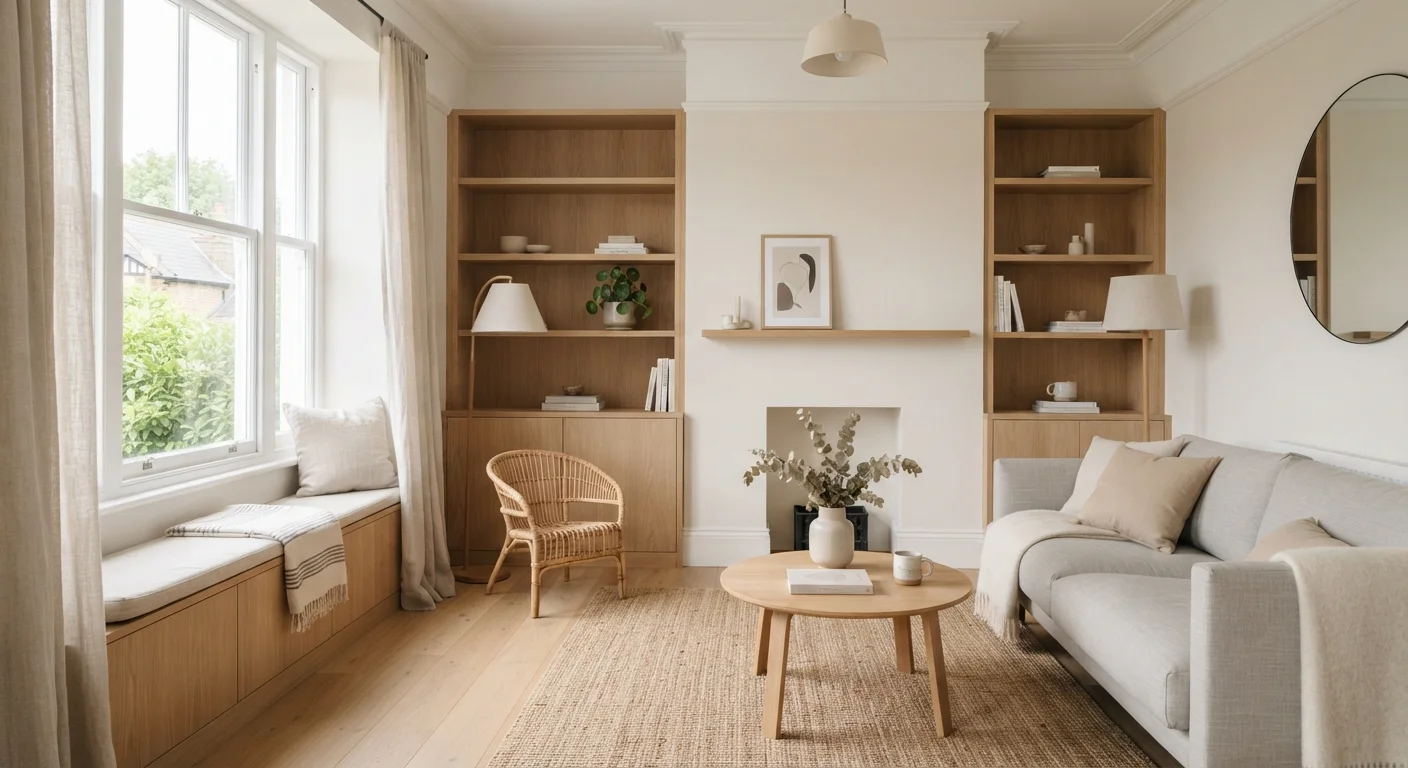
Why Popular Small-Space Advice Often Backfires
Small-space living has generated a sprawling industry of tips, products, and design advice — much of it well-intentioned but not always grounded in how rooms actually function. When people follow widely repeated strategies and still feel cramped, it's often because the advice addressed symptoms rather than causes.
The myths below are among the most common culprits. Identifying them is the first step toward a home that genuinely feels calmer and more functional. If you're also navigating where to begin, the step-by-step decluttering guide offers a practical starting point before any storage decisions are made.
Myth
Buying more storage bins and baskets will solve a clutter problem.
Fact
Adding containers without reducing the total volume of belongings simply relocates clutter rather than eliminating it.
Storage products are useful tools, but they work best after a decluttering step — not as a substitute for one. When every surface is covered in labeled baskets, the visual complexity itself contributes to a sense of disorder. Organizers work most effectively when they contain fewer items in clearly defined categories. The rule of thumb used by many professional organizers: reduce first, then contain.
Myth
Small rooms always need light, neutral colors to feel bigger.
Fact
Color choice influences perception, but it is one factor among many — contrast, lighting quality, and furniture scale often matter more.
Light walls do reflect more ambient light, which can make a room feel airier. However, a small room painted a bold, saturated color with well-scaled furniture and good natural light can feel more intentional and expansive than a pale room packed with mismatched pieces. Interior designers frequently note that a consistent, limited color palette — regardless of specific hue — reduces visual fragmentation and creates a sense of cohesion that reads as spaciousness.
Myth
Multifunctional furniture always saves space.
Fact
Multifunctional furniture saves space only when it replaces single-purpose items rather than adding to them.
A storage ottoman that sits alongside a full sofa and two side tables adds bulk, not efficiency. The real gain comes from substitution: a storage ottoman instead of a coffee table, or a sofa bed instead of a guest bed stored in a closet. Before purchasing a multifunctional piece, identify which existing items it will remove from the room entirely. If the answer is none, the net effect may be negative.
Myth
Vertical space is only useful in kitchens and closets.
Fact
Wall-mounted and ceiling-adjacent storage is effective in virtually every room — living areas, bathrooms, entryways, and home offices included.
The space between the top of furniture and the ceiling is among the most consistently underused in small homes. Floating shelves, wall-mounted cabinets, and tall bookcases draw the eye upward, creating a perception of height while freeing floor area. In entryways, hooks and narrow wall-mounted racks can replace bulky freestanding coat racks. In bathrooms, medicine cabinets recessed into walls or shelving above the toilet can double usable storage without encroaching on floor space.
Myth
You need a dedicated storage room to stay organized in a small home.
Fact
Distributed, built-in storage throughout a home is often more functional than a single dedicated storage space.
A storage room can become a catch-all that makes items difficult to retrieve and encourages hoarding items that would otherwise be discarded. Integrating storage close to where items are actually used — cleaning supplies near where cleaning happens, extra linens near the bedroom — reduces friction and makes maintaining order more natural. Small, frequent access beats one large, inconvenient deposit.
Myth
Minimalism is the only real solution for small spaces.
Fact
Intentional organization — not a specific aesthetic — is what makes small spaces functional; minimalism is one style, not a universal requirement.
Many people live comfortably in small homes with books, collections, and full kitchens. The key variable isn't the total number of possessions but whether everything has a designated place and can be returned there without effort. Forcing a minimalist aesthetic on a household that doesn't align with it often leads to rebound clutter. A more durable approach focuses on systems that fit how the household actually lives.
Building Storage Habits That Actually Last
Correcting myths is only half the work. The other half is developing habits that sustain an organized space without constant effort. A few principles tend to hold across all small homes:
- Assign every item a fixed location. Clutter typically accumulates in spaces where things have no clear home. Designated spots reduce decision fatigue and make tidying faster.
- Audit storage seasonally. Needs change. A seasonal review — even 20 minutes — prevents slow accumulation from undoing earlier progress.
- Match container size to actual use frequency. Daily items should be the most accessible; rarely used items can occupy harder-to-reach storage without disrupting flow.
68%
Americans who feel their home is disorganized
According to a survey by the National Association of Professional Organizers, roughly two-thirds of respondents felt their homes needed better organization.
Top 3
Rooms most often cited as hardest to organize
Kitchens, garages, and closets are consistently identified as the most challenging spaces in household organization surveys.
Lasting organization rarely comes from a single reorganization session. The routines that keep spaces organized long-term tend to be small, consistent, and tied to existing daily behaviors rather than major overhauls.
Don't Install Heavy Shelving Without Wall Anchoring
Wall-mounted shelving can hold significant weight, but only when properly secured to wall studs or with appropriate anchors for the wall type. Improperly mounted shelves are a safety risk, particularly in homes with children. If you're unsure about the wall structure — especially in older homes with plaster walls — consult a handyperson or contractor before installation.
For homeowners considering structural changes to gain space — such as opening walls — it's worth reviewing the trade-offs of open-plan renovation before committing to a project that may introduce acoustic or heating challenges alongside the visual benefits.
The content provided on our blog site traverses numerous categories, offering readers valuable and practical information. Readers can use the editorial team’s research and data to gain more insights into their topics of interest. However, they are requested not to treat the articles as conclusive. The website team cannot be held responsible for differences in data or inaccuracies found across other platforms. Please also note that the site might also miss out on various schemes and offers available that the readers may find more beneficial than the ones we cover.