

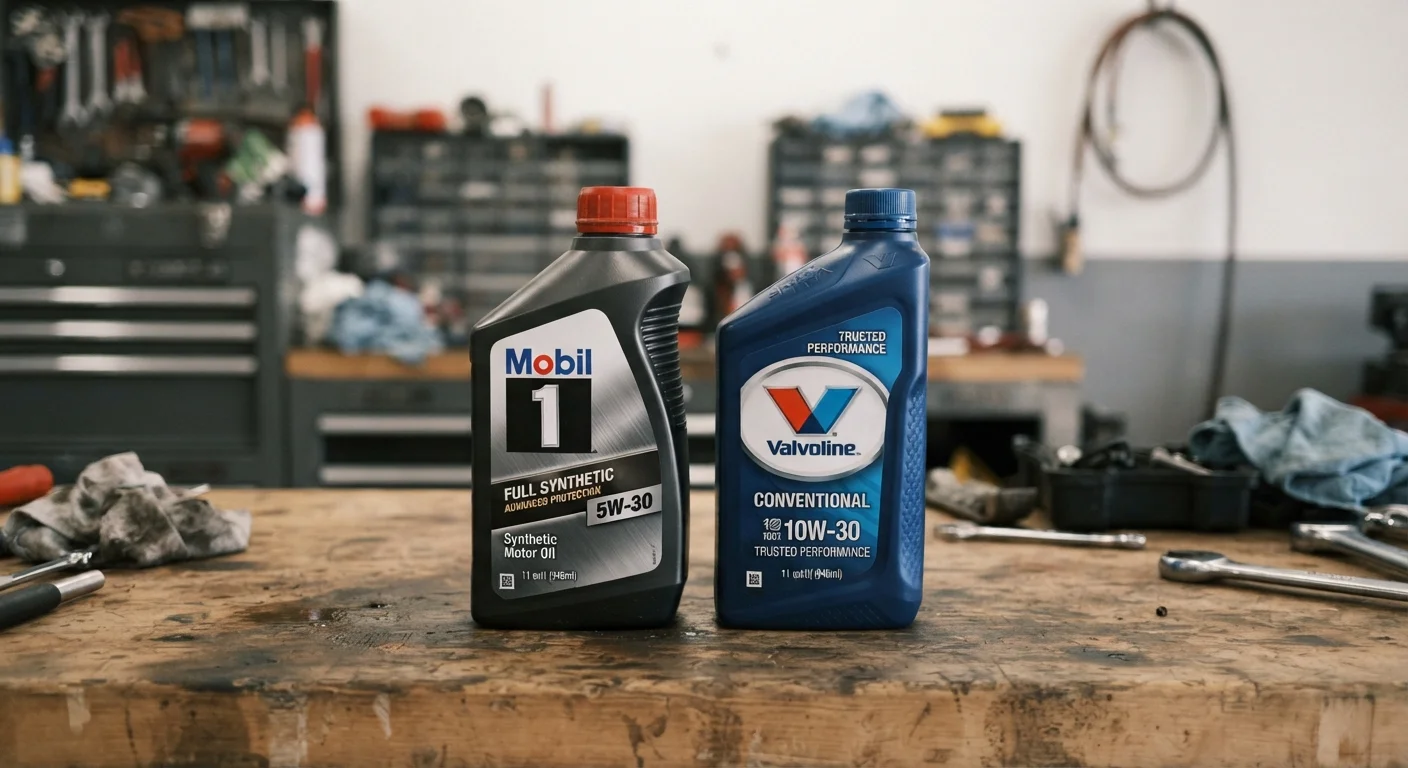
Option A
Synthetic Motor Oil
The engineered, high-performance formulation.
Best for: Drivers with newer vehicles, turbocharged engines, or those facing extreme temperatures and demanding driving conditions.
Option B
Conventional Motor Oil
The time-tested, widely available standard.
Best for: Drivers of older vehicles with simple engine designs who follow regular maintenance schedules and drive under normal conditions.
What Makes These Two Oils Different?
Motor oil's primary job is to lubricate moving engine parts, reduce friction, carry heat away, and keep contaminants suspended until the next oil change. Both synthetic and conventional oils do this — but through fundamentally different means.
Conventional motor oil is refined directly from crude petroleum. It contains a mix of hydrocarbon molecules of varying sizes, which makes its performance somewhat inconsistent at temperature extremes. It's widely available and has served engines reliably for decades.
Synthetic motor oil is manufactured through a chemical process that produces a more uniform molecular structure. This engineered consistency allows it to maintain viscosity (its resistance to flow) more reliably across a wider range of temperatures, resist oxidation longer, and leave fewer deposits in the engine over time.
Both types also contain additive packages — detergents, anti-wear agents, and friction modifiers — but synthetic base stocks generally allow those additives to work more effectively and for longer intervals.
| Criterion | Synthetic Motor Oil | Conventional Motor Oil |
|---|---|---|
| Base source | Chemically engineered base stocks | Refined crude petroleum |
| Molecular consistency | Highly uniform | Variable, mixed sizes |
| Typical change interval | 7,500–10,000+ miles (varies by spec) | 3,000–5,000 miles |
| Cold-weather performance | Flows readily at low temps | Can thicken in extreme cold |
| Heat resistance | High resistance to breakdown | More prone to oxidation |
| Engine deposit risk | Lower deposit tendency | Moderate deposit tendency |
| Suited for turbocharged engines | Yes — generally recommended | Not ideal |
| General cost per quart | Higher | Lower |
When Each Oil Type Has the Advantage
The performance gap between synthetic and conventional oil is most visible at the extremes. In very cold weather, conventional oil can thicken significantly before an engine warms up, creating a brief but real window of insufficient lubrication at startup. Synthetic oil flows more readily in those first critical seconds. In high-heat environments — or engines that run hot by design, such as turbocharged or supercharged powerplants — synthetic oil resists breaking down far longer.
For everyday driving in moderate climates with a naturally aspirated engine, conventional oil performs adequately when changed at the manufacturer's recommended interval. The key caveat: those intervals are shorter. Conventional oil typically needs changing every 3,000–5,000 miles, while many full synthetic products are rated for 7,500–10,000 miles or more, depending on manufacturer guidance and driving conditions.
~2x
Longer change intervals vs. conventional
Many full synthetic oils are rated for roughly twice the mileage between changes compared to conventional oil, according to general industry guidelines — though always follow your manufacturer's specification.
75,000 mi
High-mileage threshold for specialized blends
Many oil manufacturers and mechanics consider 75,000 miles the point at which a high-mileage-specific formulation may benefit aging engine seals and components.
It's also worth noting that high-mileage vehicles sometimes use a specialized blend — often a synthetic or semi-synthetic formulated with seal conditioners — designed to address the increased wear and slight leakage common in engines with over 75,000 miles. This isn't a strict rule, but it's a consideration worth discussing with a qualified mechanic.
For a broader look at how oil changes fit into your vehicle's full maintenance picture, see our guide to maintenance timelines most drivers misjudge.
How to Choose — and What to Watch Out For
The single most reliable source for the right oil choice is your vehicle's owner's manual. It specifies both the oil type (conventional, synthetic, or synthetic blend) and the viscosity grade — such as 5W-30 or 0W-20 — engineered for your specific engine. Using the wrong viscosity can affect fuel economy and engine protection, so this isn't a detail to overlook.
Your Owner's Manual Is the Final Word
Vehicle manufacturers test and specify oil requirements based on the exact tolerances, materials, and operating temperatures of each engine they build. If your manual calls for a specific viscosity grade or oil type, that specification should take priority over general advice — including this article. When in doubt, a qualified mechanic can help you interpret your vehicle's requirements.
If your manual doesn't specify synthetic, that doesn't necessarily mean you can't use it — but it does mean conventional oil meets the design requirement. Conversely, if synthetic is specified, that's a hard recommendation; using conventional in its place may not provide adequate protection.
One common concern is whether switching from one type to the other damages the engine. In most modern vehicles, the answer is no — but it's better to be consistent once you've chosen. Frequent switching between oil types without following proper change intervals defeats much of the benefit of either product.
Finally, remember that oil type is only part of the equation. A perfectly chosen oil that's overdue for a change offers far less protection than a modest oil changed on schedule. Staying current with service intervals matters as much as any formulation decision.
The content provided on our blog site traverses numerous categories, offering readers valuable and practical information. Readers can use the editorial team’s research and data to gain more insights into their topics of interest. However, they are requested not to treat the articles as conclusive. The website team cannot be held responsible for differences in data or inaccuracies found across other platforms. Please also note that the site might also miss out on various schemes and offers available that the readers may find more beneficial than the ones we cover.