

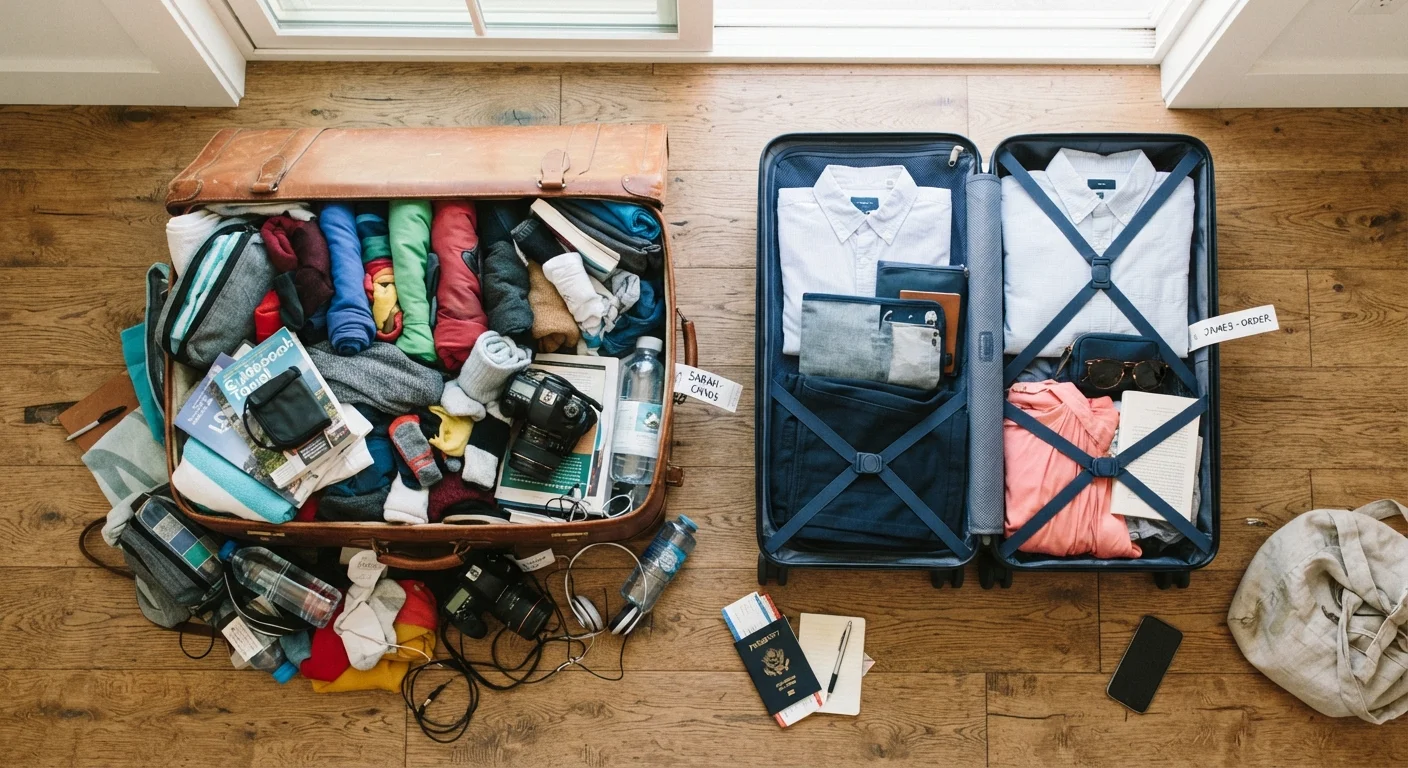
Option A
Packing Too Much
The everything-but-the-kitchen-sink approach — thorough, but costly.
Best for: Travelers who prioritize comfort, variety, and preparation for unpredictable situations over speed and simplicity.
Option B
Travelling Light
The streamlined, carry-on-only philosophy — agile and liberating.
Best for: Travelers who value flexibility, lower costs, and faster movement between destinations.
The Real Costs of Overpacking
Most travelers don't plan to overpack — it happens incrementally, one "just in case" item at a time. But those choices stack up quickly and carry tangible consequences well before you reach your destination.
The most immediate hit is financial. Budget airlines routinely charge between $30 and $70 per checked bag each way, and on multi-stop itineraries, those fees compound fast. If you're flying budget carriers on a two-week international trip, a checked bag could cost you more than a night's accommodation in some regions. That's a meaningful trade-off worth calculating before you zip anything up.
Beyond fees, heavy luggage slows you down in ways that affect your whole experience. Navigating cobblestone streets, climbing hostel stairs, or rushing a train connection becomes genuinely harder with bags that strain your back. You spend more time managing your luggage and less time enjoying where you are.
$30–$70
Typical one-way checked bag fee on US budget carriers
Fees vary by airline and route; always check the carrier's current baggage policy before booking.
~50%
Clothes travelers report never wearing on a trip
Travel industry surveys consistently find roughly half of packed clothing goes unused, pointing to systematic overpacking habits.
62 lbs
Maximum checked bag weight on most major US airlines
Bags exceeding standard weight limits typically incur overweight fees of $100 or more each way on domestic routes.
There's also the psychological weight — the constant awareness of your belongings, the anxiety of losing an overstuffed bag, and the exhaustion of keeping track of more things. Overpacking can quietly erode the freedom travel is supposed to deliver.
What Travelling Light Actually Demands
Minimalist packing looks effortless in travel blogs, but it requires more deliberate preparation than most people expect. Paring down to a carry-on or personal item isn't about deprivation — it's about precision.
The foundational skill is understanding the difference between what you'll use and what you'll want as a safety net. A second pair of formal shoes, four backup outfit options, and a full-sized hairdryer are classic "just in case" items that almost never get used. Experienced light packers rely on versatile, quick-dry fabrics, a neutral color palette that mixes and matches, and an honest assessment of their actual daily routine on the road.
| Criterion | Packing Too Much | Travelling Light |
|---|---|---|
| Baggage fees | Likely on most airlines | Often avoidable entirely |
| Mobility between destinations | Slower, more cumbersome | Fast and flexible |
| Upfront planning required | Lower — grab and pack | Higher — must be deliberate |
| Laundry dependency | Minimal | Moderate to high on long trips |
| Works best for | Long, multi-climate, gear-heavy trips | Short to medium urban or flexible trips |
| Souvenir space | Often limited by full bags | Easier to plan for intentionally |
| Physical strain | Higher — heavier loads | Lower — manageable weight |
Laundry access is the practical backbone of light travel. Knowing whether your accommodations offer laundry facilities — or whether there's a nearby laundromat — dramatically changes what you need to bring. For longer trips, planning a mid-trip laundry day is a reasonable strategy that unlocks the carry-on lifestyle for journeys of two weeks or more.
The structure of your itinerary matters here too. A trip with a consistent base makes light packing straightforward; a fast-moving multi-city route across climates demands more careful layering decisions.
How Trip Type Should Drive the Decision
Neither approach wins outright — the right strategy is context-dependent, and treating this as a binary lifestyle choice misses the point.
For short urban breaks of three to five days, travelling light is almost always the practical call. Airports, metros, and city sidewalks reward agility. A carry-on keeps you in control and, on budget carriers, directly saves money you can redirect toward experiences. See our guide to where travel budgets break down for a fuller picture of how pre-departure costs add up.
For extended trips — particularly those spanning multiple climate zones, formal events, or outdoor adventures requiring specialized gear — a checked bag may simply be the honest, practical answer. Hiking boots, cold-weather layers, or formal attire rarely compress into a carry-on alongside everything else.
Airline Policies Vary — Always Verify
Carry-on size limits, personal item allowances, and checked baggage fees differ significantly between airlines and even between fare classes on the same airline. What counts as a free carry-on on one carrier may cost extra on another. Before finalising your packing strategy, check the specific baggage policy for every airline on your itinerary — not just the primary carrier.
Family travel and trips involving medical supplies are also contexts where minimalism has real limits. Travelling light is a powerful tool, not a universal mandate. The goal is intentional packing — bringing exactly what your specific trip requires, no more and no less. For a structured way to approach this decision from the start, the travel planning from scratch guide walks through how trip type should shape every pre-departure choice.
Making the Call Before You Pack
Before you open a suitcase, a few quick questions will sharpen your approach: How many days are you traveling? How many climate shifts will you cross? Do your accommodations have laundry access? Are there activities — weddings, hiking, business meetings — that require non-negotiable gear?
If the honest answers point toward a checked bag, own that and pack with intention rather than anxiety. If they point toward a carry-on, commit to the constraint and trust the planning. Either way, a pre-trip checklist can help you verify the logistics — airline baggage policies, climate forecasts, and accommodation amenities — before you make final decisions.
The travelers who pack best aren't the ones who pack least. They're the ones who pack deliberately, with a clear-eyed view of what the trip actually demands.
The content provided on our blog site traverses numerous categories, offering readers valuable and practical information. Readers can use the editorial team’s research and data to gain more insights into their topics of interest. However, they are requested not to treat the articles as conclusive. The website team cannot be held responsible for differences in data or inaccuracies found across other platforms. Please also note that the site might also miss out on various schemes and offers available that the readers may find more beneficial than the ones we cover.