

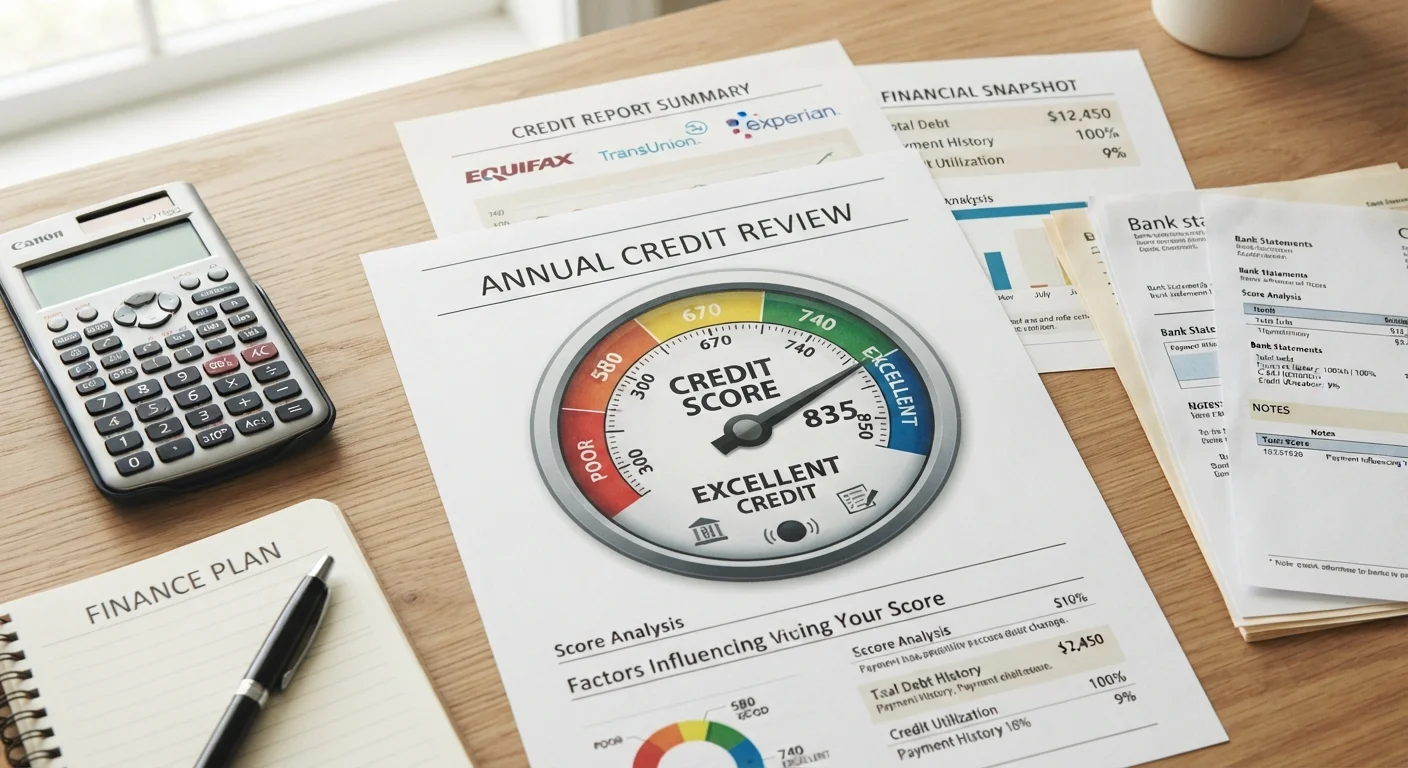
The Five Factors That Shape Your Score
Credit scoring models reduce years of borrowing behavior into a single number by weighing five core categories of information drawn from your credit report.
- Payment history (≈35%): Whether you've paid bills on time is the most influential factor. Even one missed payment can cause a noticeable drop.
- Amounts owed / Credit utilization (≈30%): This measures how much of your available revolving credit you're using. Carrying high balances relative to your limits signals risk to lenders. Keeping utilization below 30% is a commonly cited guideline.
- Length of credit history (≈15%): Older accounts and a longer average account age generally help your score. Closing old accounts can shorten your history.
- Credit mix (≈10%): Having a variety of account types — credit cards, installment loans, a mortgage — can be a modest positive signal, though this shouldn't drive borrowing decisions.
- New credit inquiries (≈10%): Applying for several new credit accounts in a short window can temporarily lower your score, as it may suggest financial stress to lenders.
These percentages reflect FICO's general weighting and can shift based on your individual credit profile. VantageScore uses similar categories but weighs them differently.
35%
Weight of payment history in FICO Score
According to FICO's published scoring criteria, on-time payment behavior is the single largest factor in most consumers' scores.
200M+
Americans with a FICO Score on file
FICO has reported that its scores are used by 90% of top U.S. lenders, covering the vast majority of credit-active American adults.
30%
Commonly recommended credit utilization ceiling
Financial educators generally advise keeping revolving credit utilization below 30% to avoid negatively impacting your score.
What Credit Scores Deliberately Leave Out
Understanding what's excluded from a credit score is just as important as knowing what's included — and misconceptions here are common.
Income and employment status are not part of any credit score. A high earner with poor payment habits can have a lower score than someone with modest income who consistently pays on time. Lenders ask for income separately during the application process.
Savings and net worth are invisible to scoring models. You could have a substantial emergency fund or investment portfolio and it would have zero direct effect on your score.
Rent payments are typically not reported to the major credit bureaus — Equifax, Experian, and TransUnion — unless you use a rent-reporting service. This is a meaningful gap for the many Americans who rent and have limited traditional credit history.
Utility and phone bills generally don't appear on credit reports when paid on time, though they can hurt you if they go to collections.
Age, race, gender, marital status, and religion are explicitly prohibited from use in scoring under the Equal Credit Opportunity Act (ECOA).
You Have More Than One Credit Score
The score you see through a bank app or credit monitoring service may differ from the score a mortgage lender or auto lender actually pulls. Lenders use industry-specific FICO versions — for example, FICO Auto Score or FICO Bankcard Score — that weigh certain behaviors differently. This is normal and doesn't indicate an error; it simply reflects that multiple scoring models exist for different lending contexts.
Why the Number Matters — and Its Limits
Your credit score affects more than loan approvals. Landlords commonly check credit before renting. Some employers review credit reports (with consent) for financially sensitive roles. Insurance companies in some states use credit-based insurance scores when setting premiums.
The financial stakes are real. A borrower with a score of 760 may qualify for a significantly lower mortgage interest rate than a borrower at 640. Over a 30-year loan, that difference can translate to tens of thousands of dollars in total interest paid.
“Credit scores are useful signals, but they are not the whole story of a person's financial life. They measure one dimension — credit risk — and should be interpreted in that specific context.”
— Consumer Financial Protection Bureau, U.S. federal agency overseeing consumer financial products and credit reporting
At the same time, a credit score is a backward-looking tool. It reflects what you've done, not what you're capable of or what your financial situation looks like today. It's one data point lenders use — not a complete picture of your creditworthiness or financial health.
For a deeper look at the credit report that feeds your score, see our guide to reading your credit report. And if you want to understand how different debt types affect the picture, our explainer on secured vs. unsecured debt is a useful complement.
Check Your Credit Report Regularly
You're entitled to a free credit report from each of the three major bureaus annually at AnnualCreditReport.com — the only federally authorized source. Reviewing your report for errors is one of the most effective steps you can take to protect your score. If you spot inaccuracies, each bureau has a formal dispute process you can use at no cost.
This article is for general informational purposes only and does not constitute personalized financial or legal advice. For guidance specific to your situation, consult a qualified financial professional.
Frequently Asked Questions
Under the FICO model, scores of 670–739 are generally considered 'good,' 740–799 are 'very good,' and 800 or above is 'exceptional.' Scores below 580 are typically classified as 'poor' and may limit loan options or result in higher interest rates.
No. Checking your own score is a 'soft inquiry' and has no effect on your credit score. Only 'hard inquiries' — triggered when a lender checks your credit after you apply for credit — can temporarily lower your score by a small amount.
Most negative items, such as late payments and collections, remain on your credit report for seven years. Chapter 7 bankruptcies can stay for up to ten years. Over time, older negative items carry less weight in score calculations.
Yes. A credit score can be generated from any credit account — auto loans, student loans, or mortgages all count. However, if you have no credit accounts at all, you may be 'unscorable,' meaning there's insufficient data to generate a score.
Income is not factored into credit scoring models. Your score is based entirely on how you've managed credit — not how much you earn. That said, lenders may separately consider income when deciding how much credit to extend.
The content provided on our blog site traverses numerous categories, offering readers valuable and practical information. Readers can use the editorial team’s research and data to gain more insights into their topics of interest. However, they are requested not to treat the articles as conclusive. The website team cannot be held responsible for differences in data or inaccuracies found across other platforms. Please also note that the site might also miss out on various schemes and offers available that the readers may find more beneficial than the ones we cover.