

Start here
What Insulation Actually Does
Next
The Main Types of Insulation
Then
Where Insulation Goes in a Home
Go deeper
Understanding R-Value
Final step
When to Call a Professional
What Insulation Actually Does
Insulation is not just about staying warm in winter. Its core job is to slow the movement of heat — keeping conditioned air inside your home longer and reducing how hard your heating and cooling systems have to work. Heat naturally flows toward cooler spaces, so in winter it escapes outward, and in summer it pushes inward. Insulation creates resistance to both directions of that flow.
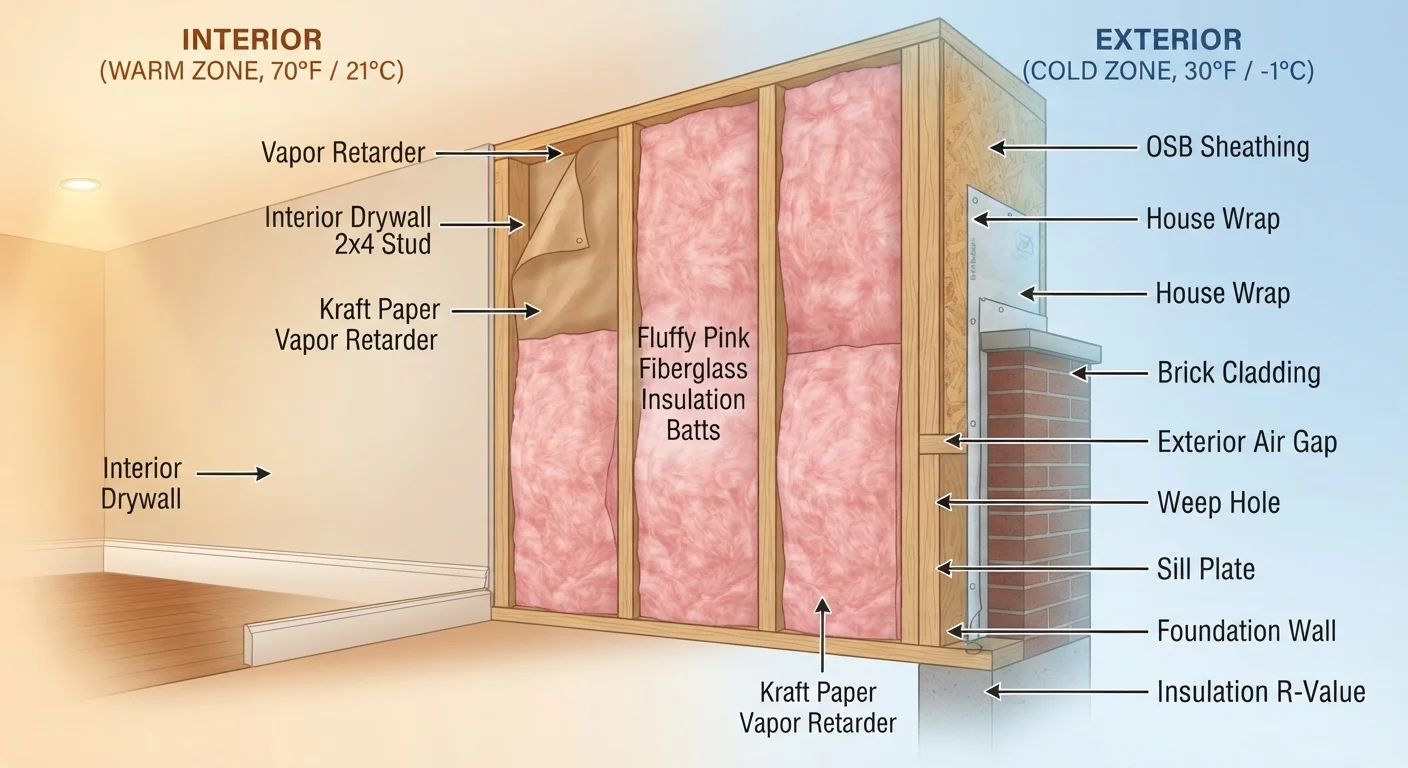
Beyond temperature, insulation also plays a role in moisture management. When warm, humid air meets a cold surface inside a wall or ceiling, it can condense — leading to mold, rot, and structural damage over time. Properly installed insulation, combined with appropriate vapor control, reduces the conditions that allow this to happen.
Noise reduction is a secondary benefit in some applications, particularly between interior rooms or floors. For most homeowners, though, energy efficiency and comfort are the primary reasons to evaluate and improve their home's insulation. See our annual home maintenance checklist to find out when and how often to inspect your insulation as part of routine upkeep.
R-value
A number that rates how well an insulation material resists heat flow. Higher R-values mean better insulating performance.
Vapor barrier
A material — often plastic sheeting or a treated facing — that limits how much moisture moves through walls, ceilings, or floors.
Thermal bridging
When heat bypasses insulation by traveling through a conductive material, like a wall stud, reducing the overall effectiveness of the insulation.
Air sealing
The process of plugging gaps, cracks, and penetrations in a home's envelope to prevent conditioned air from escaping and outside air from entering.
Conditioned space
Any area of your home that is heated and cooled by your HVAC system, as opposed to unconditioned spaces like garages or vented crawl spaces.
Blown-in insulation
Loose insulation material — usually cellulose or fiberglass — installed by blowing it through a hose into cavities or over existing insulation.
The Main Types of Insulation
Insulation comes in several forms, each suited to different installation locations and budgets.
- Fiberglass batts: The pink or yellow rolls most people recognize. These pre-cut sections fit between standard wall studs and floor joists. They are relatively affordable and widely available, but must be installed snugly without gaps or compression to perform as rated.
- Mineral wool (rock wool): Made from volcanic rock or recycled slag, mineral wool batts are denser than fiberglass and offer better resistance to fire and moisture absorption. They hold their shape well and are a common upgrade in walls and floors.
- Blown-in cellulose: Shredded, treated recycled paper blown into cavities using a hose. Excellent for attics and hard-to-reach spaces. It conforms around obstacles better than batts, though it can settle slightly over time.
- Spray foam: Applied as a liquid that expands and hardens. Open-cell foam is lighter and vapor-permeable; closed-cell foam is denser, acts as a vapor barrier, and has a higher R-value per inch. Spray foam requires professional application.
- Rigid foam board: Panels of extruded or expanded polystyrene (XPS or EPS) used on exterior walls, basement walls, and under slabs. Adds insulation without using up interior stud-bay space.
Check for Gaps Before You Add More
Adding more insulation on top of poorly air-sealed areas delivers limited benefit. Before upgrading attic insulation, take time to seal around light fixtures, plumbing penetrations, and the attic hatch with appropriate caulk or foam. This step costs very little but significantly improves results.
Where Insulation Goes in a Home
Different parts of a home have different insulation priorities. Understanding which areas matter most helps homeowners focus upgrades where they'll have the greatest impact.
- Attic
- The single most impactful location in most homes. Heat rises, so an under-insulated attic is a major source of energy loss. Blown-in cellulose or fiberglass is common here, laid across the attic floor or over existing insulation.
- Exterior walls
- New construction typically uses batts between studs. Existing walls can be upgraded with blown-in or injected foam without full renovation. Rigid foam on the exterior is another option during re-siding projects.
- Basement and crawl space
- Options depend on whether the space is conditioned or unconditioned. Insulating the crawl space ceiling (the floor above) keeps floors warmer; insulating crawl space walls brings the space into the conditioned envelope. Moisture management is especially important here.
- Floors over garages or unheated spaces
- Batts or rigid foam between floor joists keep these surfaces from feeling cold underfoot and reduce energy loss.
Crawl Spaces Require Extra Care
Crawl spaces are prone to moisture intrusion from both the ground and exterior air. Before insulating, any standing water issues or venting problems should be resolved. In many climates, encapsulating the crawl space with a ground vapor barrier is recommended alongside insulation. Local building codes vary on the specifics, so verify requirements with your local building department.
Understanding R-Value
R-value is the standardized measure of how well insulation resists heat flow. The R stands for resistance — and a higher number means greater insulating power per inch of thickness. Every insulation material has a rated R-value per inch, so thicker layers of the same material add up to a higher total R-value.
The U.S. Department of Energy publishes recommended R-values by climate zone for attics, walls, floors, and crawl spaces. Colder climates require higher R-values to compensate for larger temperature differences between inside and outside. For example, attic R-value recommendations in northern states are significantly higher than those in the deep South.
It is worth noting that R-value ratings apply to ideal lab conditions. Real-world performance can vary based on installation quality, air leakage around insulation, and moisture exposure. This is why air sealing — closing gaps around outlets, plumbing penetrations, and attic hatches — often works hand-in-hand with insulation to deliver results.
Don't Compress Batt Insulation
Fiberglass and mineral wool batts are rated for a specific thickness. Compressing them to fit a shallower space lowers their effective R-value — sometimes significantly. If a cavity is shallower than the batt, choose a product rated for that depth rather than forcing a thicker one in.
When to Call a Professional
Some insulation projects are manageable for a confident DIYer — rolling out batts in an open, accessible attic is a common example. Many others, however, involve conditions that require trained expertise.
You should consult a licensed insulation contractor or home energy auditor when:
- You are working in a finished wall, tight crawl space, or enclosed floor cavity.
- You suspect the existing insulation contains asbestos (common in homes built before the 1980s — do not disturb it without professional testing).
- You want spray foam applied — improper mixing or ventilation poses genuine safety risks.
- Your project requires a building permit, which many insulation jobs in conditioned spaces do.
- You want an objective assessment of where your home is losing the most energy.
A home energy audit — available through many utility companies and independent contractors — uses diagnostic tools to identify where insulation gaps exist before you spend money in the wrong places. It is often the smartest first step for a homeowner serious about improving comfort and efficiency. Regular inspections also fit neatly into seasonal routines — our season-by-season maintenance checklist can help you stay on top of checks like these year after year.
U.S. Department of Energy – Insulation Resources
The DOE's Energy Saver site provides R-value recommendations by climate zone, insulation type comparisons, and guidance on air sealing — all free and publicly available.
Home Energy Audit
A professional home energy audit uses blower-door tests and thermal cameras to identify exactly where heat is escaping. Many utility providers offer subsidized audits — check with your local utility.
ENERGY STAR Home Sealing Guide
ENERGY STAR publishes a practical guide to locating and sealing air leaks throughout the home, which pairs directly with any insulation upgrade project.
Frequently Asked Questions
Common signs include uneven room temperatures, high heating and cooling bills, and drafts near exterior walls or the attic hatch. A home energy auditor can use a blower-door test and thermal imaging to pinpoint gaps without guesswork.
Insulation slows heat transfer, while a vapor barrier (or vapor retarder) limits moisture movement through walls and ceilings. Both often work together — but they serve distinct functions. Some insulation products include a built-in vapor retarder facing.
Yes. Blown-in or injected foam insulation can be added through small holes drilled from outside or inside, then patched. This is a job for a qualified contractor, as improper installation can trap moisture or miss cavities entirely.
Once fully cured, closed-cell and open-cell spray foam are generally considered stable and non-toxic. During and immediately after application, fumes require professional ventilation and protective equipment — it is not a DIY-safe product.
Some insulation materials, particularly dense-pack cellulose and certain mineral wool products, provide meaningful sound dampening between interior rooms. However, true acoustic insulation is a separate design consideration with its own specifications.
Most insulation materials last 20–80 years under normal conditions, but performance can degrade if insulation gets wet, compresses over time, or is disturbed by pests. Attic insulation in particular should be inspected periodically as part of routine home maintenance.
The content provided on our blog site traverses numerous categories, offering readers valuable and practical information. Readers can use the editorial team’s research and data to gain more insights into their topics of interest. However, they are requested not to treat the articles as conclusive. The website team cannot be held responsible for differences in data or inaccuracies found across other platforms. Please also note that the site might also miss out on various schemes and offers available that the readers may find more beneficial than the ones we cover.