

Why Most Exercise Routines Fail Within Weeks
The most common reason people abandon exercise plans isn't lack of willpower — it's poor design. Routines built on optimism rather than reality collapse when life asserts itself. A missed session triggers guilt, guilt triggers avoidance, and the habit dissolves. Understanding this pattern is the first step to building something different.
Effective routines account for three real-world constraints: time variability (your schedule changes week to week), energy variability (you won't always feel motivated), and life interference (illness, travel, and stress are inevitable). A good plan absorbs disruption rather than breaking under it. Pairing a consistent evening wind-down with your fitness schedule can also improve sleep quality and recovery — see our guide to building a calming evening routine for practical strategies.
Consult a Professional Before Starting
If you have a chronic health condition, recent injury, or have been sedentary for an extended period, speak with your healthcare provider before beginning a new exercise program. This article offers general educational guidance and is not a substitute for personalized medical advice. Your doctor or a certified fitness professional can help you identify safe starting points for your specific situation.
The steps below walk you through building a weekly plan that fits your actual life — not a hypothetical, unconstrained version of it.
What You'll Need Before You Start
Building a sustainable routine requires a little groundwork. Review the prerequisites and tools below before working through the steps — they'll help you move through the planning process efficiently.
What you will need
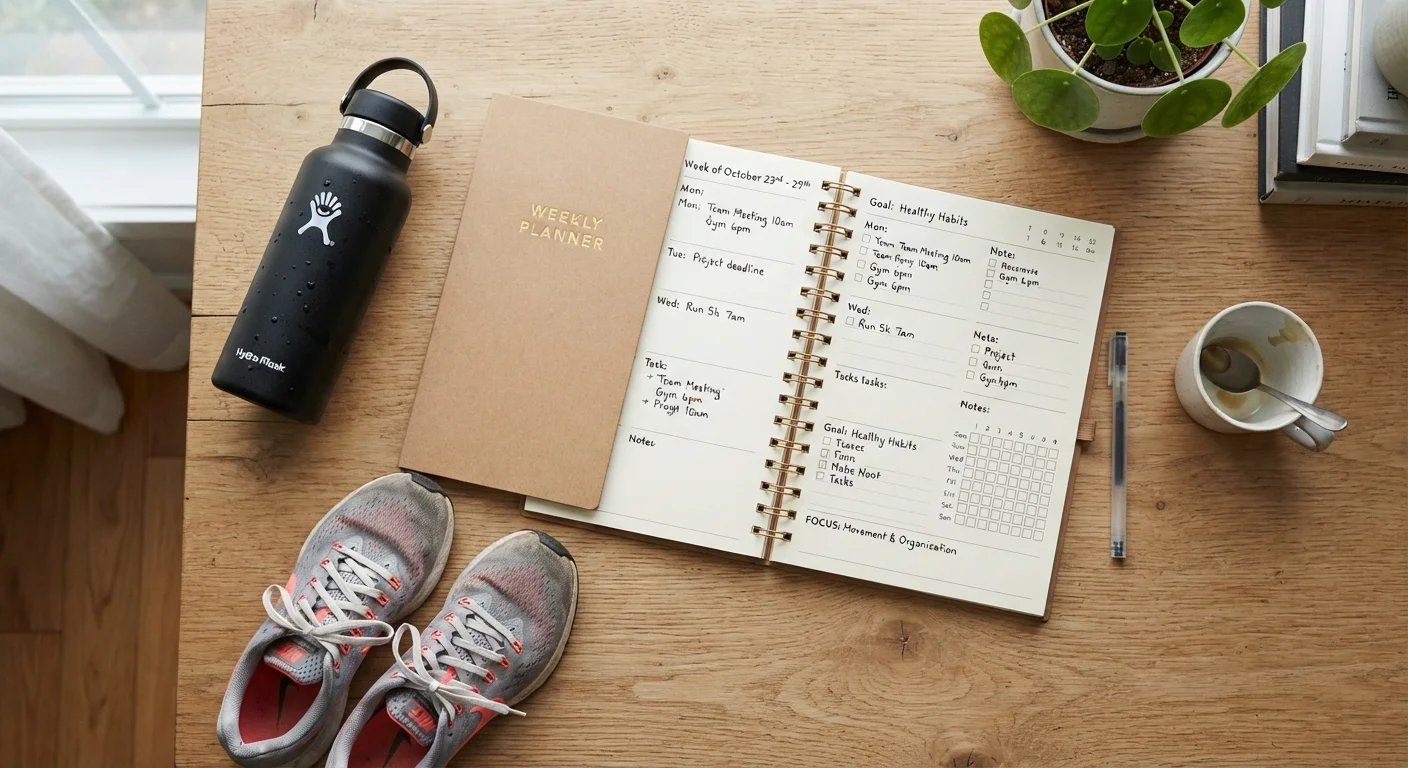
Weekly calendar or planner
Used to map out your schedule, identify open time slots, and commit workout sessions as fixed appointments.
Fitness tracking app or journal
Helps you log workouts, monitor progress over time, and identify patterns in energy and performance.
Heart rate monitor or smartwatch
Provides real-time intensity feedback during cardio sessions to help you train in appropriate effort zones.
Resistance bands or dumbbells
Enables strength training sessions at home without requiring a gym membership.
Avoid the All-or-Nothing Trap
One of the most common reasons exercise routines fail is setting an unsustainable initial schedule — six days a week for someone who currently exercises zero. Jumping in too aggressively increases injury risk and burnout. Start conservatively and build gradually; adding one session per week over a month is a more reliable path than a perfect plan you can't sustain past the second week.
How to Build Your Weekly Routine
Follow these steps in sequence. Each builds on the last, and skipping ahead — especially past the honest scheduling audit — is where most plans go wrong.
Audit your current schedule honestly
Before choosing workout days, map out your actual week — not the ideal one. Note work hours, family commitments, commute time, and existing obligations. Look for three to five windows of at least 30 minutes where you are realistically free and have reasonable energy. Most people overestimate their evening availability; mornings often prove more reliable for consistency.
Set a specific, modest starting goal
Translate your audit into a concrete weekly target. For general health, public health guidelines generally suggest at least 150 minutes of moderate-intensity aerobic activity per week, plus muscle-strengthening activities on two or more days — but your starting point should reflect where you are now, not where guidelines say you should be. If you currently do nothing, committing to three 30-minute sessions per week is a meaningful and achievable step forward.
Choose a mix of activity types
A balanced routine typically combines three elements: cardiovascular exercise (walking, cycling, swimming, jogging) to support heart health; resistance or strength training (bodyweight exercises, weights, resistance bands) to maintain muscle mass and bone density; and flexibility or recovery work (stretching, yoga, foam rolling) to reduce injury risk and improve movement quality. You don't need all three every session — distribute them across the week based on your available time and preferences.
Schedule rest and recovery days deliberately
Rest days are not wasted days — they are when your muscles repair and adapt. Plan at least one full rest day per week, and consider alternating harder effort days with lighter ones. Active recovery (a gentle walk, light stretching) counts and can be preferable to complete inactivity for some people. Ignoring recovery is one of the fastest routes to overuse injuries and motivation collapse.
Block your sessions as non-negotiable appointments
Add your planned workouts to your calendar exactly as you would a meeting or medical appointment. Give each session a specific time and location (gym, living room, park). Research consistently shows that implementation intentions — the "when, where, and how" of a planned behavior — substantially improve follow-through compared to vague intentions like "I'll exercise this week."
Build in a structured review after four weeks
After four weeks, assess honestly: Which sessions happened consistently? Which were regularly skipped and why? Adjust timing, activity type, or session length based on what you learned — not what you wished would work. A routine that gets done imperfectly is always more effective than a perfect plan that doesn't happen. Progress at this stage is often subtle; knowing what signals to look for helps you stay the course. See signs your exercise routine is working for a practical guide to tracking non-scale markers of fitness improvement.
Pair Exercise With an Existing Habit
Attaching a new workout session to something you already do reliably — like a morning coffee ritual or a lunch break — dramatically lowers the mental friction of getting started. Behavioral science refers to this as 'habit stacking,' and it's one of the most practical tools for embedding new routines into a busy schedule.
Remember that the goal at this stage is not peak performance — it's establishing a habit loop your future self can maintain and build on.
Keeping the Momentum Going
Once you've completed your first four-week cycle, the temptation is to dramatically increase intensity or volume. Resist this impulse. A general guideline used by exercise professionals is to increase total weekly training load by no more than roughly 10% per week — a heuristic intended to reduce overuse injury risk, though individual responses vary. Gradual progression keeps the routine challenging without becoming unsustainable.
Track your consistency, not just your performance. Showing up regularly — even for shorter or easier sessions during stressful weeks — is the most important metric in the early months. Physical and behavioral changes accumulate quietly before they become visible. If you find yourself doubting whether anything is working, learn to recognize the non-obvious signs of fitness progress that most people overlook.
This article is for general informational and educational purposes only and is not a substitute for professional medical advice, diagnosis, or treatment. Always consult a qualified healthcare provider before beginning any new exercise program.
The content provided on our blog site traverses numerous categories, offering readers valuable and practical information. Readers can use the editorial team’s research and data to gain more insights into their topics of interest. However, they are requested not to treat the articles as conclusive. The website team cannot be held responsible for differences in data or inaccuracies found across other platforms. Please also note that the site might also miss out on various schemes and offers available that the readers may find more beneficial than the ones we cover.